

 Australia
 USA
 UK
 Canada
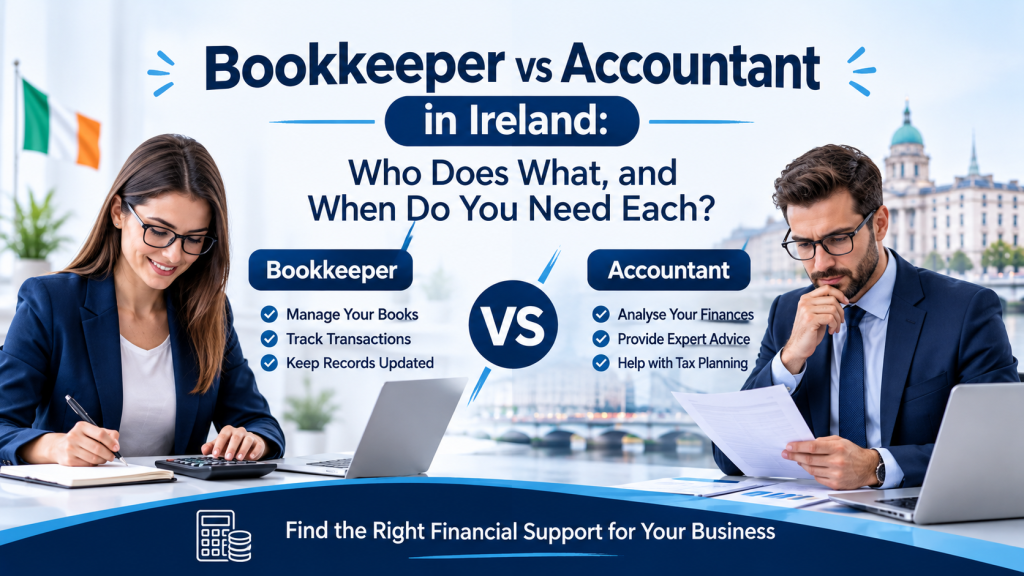




Your Accountant requests accounting documentation before the CT1 deadline. You think everything was already done. However, several bank transactions haven’t been matched, receipts are missing, and your accounts aren’t ready.
This is a very common situation where business owners don’t understand the difference between a bookkeeper and an accountant. Both manage business finances, but they do different tasks. Your bookkeeper is responsible for maintaining records during the year. Those records help an accountant create year-end accounts, complete tax returns, and provide advice. So, do you require a bookkeeper, an accountant or what will work best for you: bookkeeper vs accountant? Here are some guidelines for making the decision.
Bookkeeper vs Accountant: What’s the Difference?
The major difference between bookkeeper and an accountant is how they work with your financial information.
The bookkeeper keeps track of what happens in your business. An accountant reviews those accounts and uses them to prepare financial statements, calculate your taxes, and explain your finances.
Here is the simple comparison.
| Area | Bookkeeper | Accountant |
| Main Responsibility | Records and organises transactions | Prepares accounts, tax returns, and financial advice |
| When They Work | Weekly or monthly | Year-end, tax deadlines and reviews |
| Typical Records | Reconciled records, monthly profit and loss, balance sheet | Year-end financial statements, tax calculations, and financial advice |
| Irish Filings | Prepares supporting records | Prepare CT1, Form11, and annual return filings |
| Qualifications | No general legal qualification | Professionally qualified and statutory audit requirements. |
| Communication | Regular contact about transactions | Contact around reviews, accounts, and tax matters |
Bookkeeping is another service an accountant can offer. However, you should never assume this is included in your agreement.
What Does a Bookkeeper Do in Ireland?
A bookkeeper maintains your business’s finances in a well-documented and accurate manner all year round. They typically do the following:
1. Recording financial transactions
A bookkeeper enters your business income, purchases, payments and more in your accounting software.
For instance, when you buy €450 worth of office stationery, they add it to the appropriate account.
2. Reconciling bank accounts
They check to see if your books match your bank statements and credit card statements.
They look into and correct any payments that are missing or double-counted.
3. Organising receipts and documents
Bookkeepers compare receipts and invoices with transactions. They also identify any missing documents and request them before the end of the year.
4. Completing month-end checks
They review monthly transactions, balance and verify for errors at the end of the month.
This helps to avoid small errors accumulating over the course of a few months.
5. Preparing monthly reports
The bookkeeper can prepare simple financial reports such as:
- Profit and loss statement: This statement will display your income, expenses and profit.
- Balance: A report of the income and expenses shows what the business owns, owes and its equity at a particular date.
- Transaction reports: Show the financial transactions made for the month.
These reports provide you with information about your business and its performance.
What doesn’t a bookkeeper normally do?
Generally, a bookkeeper does not give special tax advice, sign statutory accounts or be an authorised tax agent for your business.
Some bookkeepers may have extra certifications and provide more services. Always inquire what is included.
For more details, you can read our Small Business Bookkeeping in Ireland: A Complete Guide.
What Does an Accountant Do in Ireland?
An accountant examines your financial transactions and prepares your accounts as well as helping to determine the taxes that you need to pay and make business decisions.
They have primary duties of:
- Preparing year-end accounts
Accountants review bookkeeping records, adjust it as needed and issue year-end financial statements. These can be depreciation, accruals, pre-payments and other accounting adjustments.
- Preparing corporation tax returns (CT1)
The usual way for Irish companies to pay CT (corporation tax) is for them to submit a CT1 return to Revenue.
The accountant or tax adviser completes the tax computation and typically lodges this on the Revenue Online Service (ROS), as to which they are engaged.
- Preparing Form 11 returns
Certain company directors and sole traders need to file a Form 11 income tax return.
An accountant can calculate taxable income, review the various reliefs, and prepare the tax return.
Not all directors are required to file Form 11. The requirement depends on their taxation circumstances.
- Supporting CRO annual returns
Limited companies are required to provide an annual return, typically Form B1, to the Companies Registration Office (CRO), Ireland.
The financial statements for this filing may be prepared by an accountant. The B1 itself could be prepared by an accountant, the company secretary, or another preparer.
- Providing tax and financial advice
Accountants can also assist with tax planning, business structure and finances.
Depending on their workflow and revenue authorisation, they may be your authorised agent on ROS.
Qualifications: Does a Bookkeeper or Accountant Need to Be Qualified?
In Ireland, there is no specific legal requirement to possess a qualification to undertake ordinary bookkeeping.
However, experience matters.
When looking for a bookkeeper, ensure they know how to use accounting software, reconcile bank statements, and understand business records in Ireland and ask for references from previous clients.
If you are an accountant, check for professional credentials and experience that are relevant.
- Chartered Accountants Ireland
- Association of Chartered Certified Accountants (ACCA)
- Chartered Institute of Management Accountants (CIMA)
CPA Ireland merged with Chartered Accountants Ireland in September 2024.
Does every accountant need to be registered?
There is no requirement for any accounting or tax service to be a member of a professional organisation. However, an accountant who performs statutory audits must have the necessary audit authorisation.
Preparing accounts and conducting a statutory audit are separate services.
If your company is eligible for an audit exemption, consult your accountant about the current situation.
Who Handles What Throughout the Irish Financial Year?
Bookkeeping and accounting processes work best when both are planned throughout the year.
Here is how their responsibilities fit together.
| When | Bookkeeper | Accountant |
| Every month | Records transactions, reconciles accounts, checks documents | Review reports where needed |
| Every Quarter | Update records and resolve missing entries | Review financial statements |
| Financial year end | Finalise records and provide trial balance | Prepare year-end financial statements |
| CT1 Deadline | Provide supporting transaction records | Prepare accounts and CT1 |
| CRO annual return | Supplies financial information | Prepares accounts and B1 filing |
| Form 11 deadline | Keep sole traders’ records ready | Prepare the income tax return |
Important filing deadlines in Ireland
- CT1 Corporation Tax Return: A company generally files its corporation tax return within nine months of its accounting period ending. The normal ROS period is the 23rd day of the 9th month. A company with an end of year of 31 December 2025 would have their CT1 filing date on 23 September 2026.
- CRO annual return: Companies generally have 56 days from their Annual Return Date (ARD) to file the annual return. Other timing provisions are in place where financial statements are required.
- Form 11 income tax return: The normal filing period for the previous year’s tax return is 31 October. May offer an extended ROS deadline to taxpayers who satisfy electronic filing and payment requirements.
- For 2025 Form 11 returns, the extended ROS deadline is 18 November 2026.
Do I need a bookkeeper or an accountant?
Not all Irish businesses require professionals from the beginning.
This depends on your transaction volume, your business, and the amount of work you can do yourself.
| Business Type | What Actually Makes Sense |
| New Sole Trader | An accountant for tax advice; you may simply record transactions yourself. |
| Sole Trader with growing transactions | A bookkeeper for monthly records and an accountant for tax |
| Limited company director | Both due to all kinds of workflows |
| Growing SMB | Both with regular communication between them |
For instance, those who are self-employed with only a handful of transactions in a month might be ok with maintaining their own books.
If a business has hundreds of transactions per month, however, it’ll require someone to handle the bookkeeping regularly.
You don’t need two separate providers. A few companies provide bookkeeping and accounting services in a single package.
If you’re considering different arrangements, read our Outsourced Bookkeeping vs In-House Bookkeeping guide.
Signs It’s Time to Hire a Bookkeeper
When to hire a bookkeeper: let’s know this:
- You are several months behind on recording transactions.
- Your bank balances don’t match your accounting software.
- You have receipts and invoices stored in different places.
- You cannot easily tell whether your business is making a profit.
- Your accountant regularly asks for missing records.
- Bookkeeping takes too much time away from running your business
Signs: It’s Time to Hire an Accountant
Think about consulting with an accountant if:
- You’ve decided to form a Limited Company.
- You must submit your first CT1 or Form 11.
- You require assistance in preparing statutory accounts.
- You are unsure of your director tax responsibilities.
- Your business is expanding or is getting more complex.
- You need to seek advice on audit exemption rules.
How Do a Bookkeeper and Accountant Work Together?
The bookkeeper maintains the books. The accountant, after reviewing, carries out the adjustments necessary for year-end reporting and tax.
Before sending the records to your accountant, check that:
- Bank and credit card accounts are reconciled.
- Receipts and invoices are matched to transactions.
- Income and expenses are correctly categorised.
- The closing trial balance or reports are available.
- Missing documents have been identified.
- Outstanding questions have been answered.
The accountant can review the work and make year end adjustments. Both the accountant and bookkeeper can decide the task and complete it.
Three Common Mistakes to Avoid
There are three common errors to steer clear of when doing this.
- Assuming your accountant handles everything
Some accountants offer bookkeeping services monthly, while others specialise in year-end accounts and tax.
- Leaving bookkeeping until year-end
It becomes much more difficult to locate receipts if they are missing, or to clarify transactions that happened a few months ago. Keeping your records up-to-date puts you in a better position at year-end.
- Expecting software to do everything
Some tools can assist with recording and organising transactions, like Xero, QuickBooks and Sage. Someone still needs to review the records.
Need Help With Bookkeeping or Year-End Accounts in Ireland?
Bookkeepers and accountants perform different functions, but work on the same financial data. If records are kept all year round, it makes year end accounting and tax filing easier.
We support Irish businesses and accounting firms when it comes to bookkeeping, year-end accounts preparation and CT1 and Form 11 services at Aone Outsourcing.
We can work with your needs from regular bookkeeping support to preparing your year-end accounts.
Explore Our Outsourced Bookkeeping Services in Ireland or get in touch with us for all kinds of accounting requirements.
Frequently Asked Questions
Q1. What is the difference between a bookkeeper and an accountant?
A bookkeeper documents transactions, matches bank records and maintains financial records. Those records are essential for an accountant to use when preparing year end accounts, when completing tax returns and when giving financial advice. Bookkeeping involves continuous work, and accounting involves more tax and financial decision-making.
Q2. Do I need a bookkeeper if I already have an accountant?
You may still need one. There are some accountants who only deal with year end accounts and tax returns. If you have not agreed to bookkeeping on a monthly basis, then you will need to keep those records or get a bookkeeper to do it for you. Don’t assume that you need all of it – review what your accountant already offers.
Q3. Can a bookkeeper file my CT1 or Form 11 in Ireland?
Certain returns may be prepared or submitted by a bookkeeper, who is adequately knowledgeable and authorised to do so. For most companies, however, CT1 and Form 11 can be submitted to accountants or tax agents. All tax agents must be authorised to act as a tax agent by Revenue and have access.
Q4. Does a bookkeeper need to be qualified in Ireland?
There is no general requirement for a formal qualification for an ordinary Bookkeeper in Ireland. But practice and training are essential. Before hiring, look at their accounting software skills, their knowledge of reconciliation and their references.
Q5. Do sole traders need both a bookkeeper and an accountant?
Not always. For a small business with very few sales or transactions, the business owner could handle bookkeeping and filing, and an accountant could be used for tax returns and advice. When more transactions occur, standard accounting assistance can be more beneficial.
Q6. Who prepares year-end accounts in Ireland?
An accountant prepares financial statements at year-end based on the business’s financial records. The accountant verifies the balances and makes adjustments as necessary.
Q7. When should I hire a bookkeeper?
You can consider hiring a bookkeeper when records lag, bank reconciliations are complicated, or you cannot readily review your business’s profit. If your accountant is constantly asking for missing documents at the end of the year, regular support can help.