

 Australia
 USA
 UK
 Canada
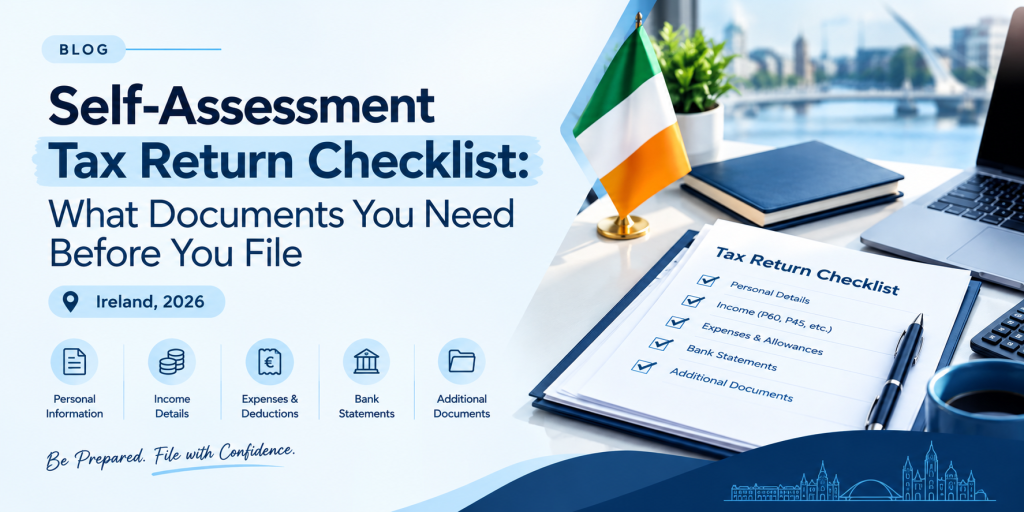




Every October, you’ll be hunting for a March invoice and a ROS certificate you can’t quite remember setting up. If that sounds familiar, you’re not alone. Nobody loves hunting for paperwork, but leaving it late makes it expensive. Your 2025 Form 11 is due on Saturday 31 October 2026. Revenue adds a surcharge of 5% of your tax bill if you file within two months of the deadline and 10% after that (capped at €12,695 and €63,485, respectively), plus interest on anything unpaid.
Do You Even Need to File?
According to Revenue’s guide to self-assessment, you must be registered for self-assessment and so file a Form 11 if either of these is true:
- Your taxable non-PAYE income is above €5,000.
- Your gross non-PAYE income is above €30,000.
A proprietary director must file whatever the amount. Broadly, that means a director who controls more than 15% of the company. Sole traders, landlords and freelancers almost always cross one of the two limits.
If your non-PAYE income is below both limits, you declare it on Form 12 in myAccount instead, and Revenue adjusts your tax credits to collect the tax. Our Form 11 vs Form 12 guide covers the borderline cases. For the full Pay and File process, see our self-assessment tax return guide.
If you have never filed a self-assessment tax return, you need to register first. The FAQs below explain how. Check the thresholds below to see whether you need to file a tax return in Ireland at all.
The Document Checklist (By Category)
Start with this table to see which groups apply to you. The details follow.
| Document | Sole trader or freelancer | Landlord | Proprietary director | PAYE with other income |
| PPSN and ROS access | ✓ | ✓ | ✓ | ✓ |
| Income summary and invoices | ✓ | If self-employed | ||
| Payment platform statements | ✓ | If you sell online | ||
| Rent records and agent statements | ✓ | If you let property | ||
| Mortgage interest certificate | ✓ | If you let property | ||
| Dividend vouchers | ✓ | |||
| Employment Detail Summary | If on payroll | ✓ | ||
| Expense records | ✓ | ✓ | If other income has costs | |
| Full-year bank statements | ✓ | ✓ | ✓ | ✓ |
| Capital gains records | If you sold anything | If you sold anything | If you sold anything | If you sold anything |
| Proof for credits and reliefs | ✓ | ✓ | ✓ | ✓ |
1. Identity and Access
- PPSN. Once you register for self-assessment, your PPSN becomes your tax reference number.
- ROS access. You can’t file a Form 11 without it. Setup has three steps: apply for an ROS Access Number, apply for your digital certificate, and then download and save the certificate. You can’t get into ROS until the third step is done. If you already have myAccount, look for Register for ROS under Manage My Record.
- Your saved certificate file. If you registered years ago, find it now. Don’t discover in the last week that it is missing.
- myAccount login. You need it for Form 12 and for checking your revenue record.
2. Income Records
Everything here is for the 2025 tax year, 1 January to 31 December 2025.
Sole traders and freelancers
- A full-year income summary from your invoicing system or spreadsheet.
- A list of invoices you issued but had not been paid for at 31 December 2025.
- Statements from payment platforms such as Stripe, PayPal or Etsy. Payouts arrive after the platform takes its fees, so the amount in your bank is lower than what you earned. Record the gross sales, and treat the fees as an expense.
- Records of grants, subsidies and cash payments.
Landlords
- A rent schedule for each property: tenant, dates and amounts received.
- Letting-agent statements for the year.
- Your lender’s mortgage interest certificate.
- Your tenancy registration details with the RTB.
- Invoices for repairs and other property costs.
Proprietary directors
- Dividend vouchers, or a record of every dividend the company paid you.
- Your Employment Detail Summary or P60 if you also take a salary.
- Confirmation of your shareholding.
PAYE employees with other income
- Your Employment Detail Summary or P60.
- Statements for any pension or taxable social welfare payments.
- The records above for whichever other income you have.
Revenue pre-fills pay, tax and USC data from your PAYE employment on the Form 11. Open the form first, check those figures against your summary, and chase paperwork only where something looks wrong.
3. Expense Records
- Receipts and invoices documenting business expenses. Digital copies are fine, as long as you can produce them if Revenue asks.
- An expense report or spreadsheet with the same total amount as you will enter.
- Invoices for equipment or a vehicle bought in 2025. These are usually claimed as capital allowances over several years, not as a one-off expense, so keep the invoice, the date and the price.
- Mileage logs and fuel records if you claim vehicle costs.
- Your workings for home-office costs, with the bills behind them.
For what you can and can’t claim, see our guide to allowable expenses for sole traders.
4. Bank and Financial Records
- Full-year statements for all business-related financial accounts from January 1, 2025, to December 31, 2025. For financial accounts where personal and business use are mixed, separately mark which lines are business.
- Credit card statements, if you used a card for business.
- Loan or finance agreements linked to the business.
Before you file, match your bank totals against your income summary. If they don’t agree, find out why now, not after Revenue asks.
5. Capital Gains Records
The Form 11 also covers capital gains. You need this group if you sold, gave away or swapped an asset in 2025, such as a property, shares or crypto.
- The contract or sale documents. For a disposal under a written contract, Revenue treats the contract date as the date of disposal.
- The purchase price and date of acquisition of the asset․
- Costs of buying‚ selling or improving the property‚ such as solicitor and auctioneer fees․
- For cryptocurrency, records of all your cryptocurrency transactions at all exchanges and other accounts
- Receipts proving that you have paid any CGT due․
CGT is due on 15 December for disposals made from 1 January to 30 November, and on 31 January for December disposals. For 2025 disposals, both dates have passed, and interest can run on late payments. You still report the gain on your Form 11, including the CGT you already paid.
6. Tax Credits and Reliefs
Gather proof only for what you claim:
- Medical expense receipts.
- Tuition fee receipts.
- Pension contribution statements.
- Supporting documents for any family or carer credit.
Check any health insurance tax credits you have received on your revenue account via myAccount. Health insurance relief is normally given through your insurer, so check your annual statement before assuming you need to claim it again.
7. Prior-Year Records
- Last year’s Form 11 acknowledgement and Notice of Assessment.
- Records related to advance tax payments for 2025. You pay your 2025 balance and your 2026 preliminary tax on the same date, so you need to know what you have already paid.
- Anything carried forward, such as capital losses or an unused Help to Buy balance.
Downloadable Checklist
Prefer a printable version? Enter your details, and we’ll send the one-page checklist to your inbox. Tick each line as you go.
Missing a Document? What to Do
Don’t invent a figure. Use a documented estimate, not a guess.
- Lost receipt or invoice. Ask the supplier for a copy․ If you can’t get a copy of the receipt or invoice, other acceptable documents include a bank or credit card statement showing the payment transaction and a short note saying what the payment was for
- Missing bank statement. Download it from online banking or ask your bank for a copy. Request the whole year at once, so you don’t find another gap later.
- No Employment Detail Summary or P60. Look in my account. Revenue pre-fills your PAYE figures in the Form 11, so you may not need the paper at all.
- A figure you can’t pin down before the deadline. A reasonable estimate you can explain is better than a blank field or a late return. Write down how you worked it out, then amend the return once you have the real number. If the gap is large, speak to your accountant before you file.
- Who to ask. Contact Revenue for things only Revenue holds: ROS access problems, pre-filled data and your Notice of Assessment. Ask your accountant about issues with your records, such as missing receipts and other documentation.
If your books are in a worse state than a few missing items, our bookkeeping catch-up service rebuilds them before you file.
How Long to Keep These Records
Under Section 886 of the Taxes Consolidation Act 1997, you must keep the books and records behind your return for six years. If Revenue starts an investigation, claim or appeal within that period, you keep them until it ends. A penalty applies for failing to keep a proper record of tax documents.
Revenue does follow up. Revenue’s 2025 Annual Report states that Revenue conducted 237,550 audit and compliance interventions in 2025, yielding €734 million. That figure covers all taxes, not only self-assessment, but it shows why six years of tidy records are worth keeping.
You can keep records in electronic form as long as you can produce them when Revenue contacts you with a notice requiring you to produce records.
If you are a director, your company has its own record-keeping duties under company law. This section is about your personal tax records.
The Documents That Catch People Out
Most checklists stop at receipts and bank statements. These are the items that get missed:
- Crypto swaps and spending. Selling is not the only taxable event. Swapping one coin for another, or spending crypto, counts as a disposal. Transferring crypto between wallets you own is not a taxable transaction․
- Share options and share incentives. These can create taxable income or gains. Keep your grant, exercise and sale statements.
- Foreign income. Rent, dividends or gains earned abroad may need to be reported. Keep records of taxes paid to foreign governments․
- Split Year Treatment. If you arrived in or left Ireland in 2025, check whether this treatment applies. The 2025 Form 11 asks for details of any claim.
- Help to Buy balances. The 2025 Form 11 again includes a place to claim an unused Help to Buy balance carried forward.
- CGT you already paid. Paid in December or January? You still report the disposal on the Form 11.
Conclusion
Collecting the required documentation is the slowest part of a Form 11. Once the documents are in one folder, the filing is much quicker. Work through the checklist for your filer type, check Revenue’s pre-filled figures, and make sure your ROS access works well before the last week. Then file and pay on ROS to use the 18 November date.
If you’d rather leave your self-assessment tax return in Ireland to us, our Irish team can prepare and file it for you.
FAQs
Do I Need to Report Cryptocurrency on My Form 11?
Yes‚ if you sold‚ swapped, or spent crypto in 2025 for a profit or loss․ The tax rate on crypto profits is 33%‚ with a €1‚270 annual exemption․ Keep all records related to your crypto transactions, including those involving multiple exchanges and other wallet services.
I Don’t Have an ROS Digital Certificate Yet. Can I Still File in Time?
Possibly, but start today. The 18 November extension applies only if you file and pay on ROS. Allow time for the access number to arrive.
What Documents Do I Need if I’m Filing for the First Time?
Register for a self-assessment tax return through myAccount‚ ROS‚ or using Form TR1. Gather information from the new year about your income․
Can Revenue See My Bank Account When I File a Self-Assessment?
Not just because you file. Revenue can request bank records with proper authorisation under section 906A of the Taxes Consolidation Act․ Keep bank and other records to support the income you report on your tax return.
What Happens if I File Without All My Documents Ready?
Filing late costs more than filing a return without all the required information. Submit an estimated value and an explanation of how you estimated the value․ File an amended ROS return after receiving the missing information.
What If I Miss the Deadline?
Filing late adds a 5% surcharge within two months, then 10%, with interest on unpaid tax. The caps are €12,695 and €63,485. File it as soon as possible.
What If I Have No Receipts?
Make use of your bank statement or your card statement․ Alternatively, ask the supplier for a copy while noting how you reached any estimate. Your accountant can indeed assist if the gap happens to be large․