

 Australia
 USA
USA UK
UK Canada




Year-end accounting is more than closing the books at the end of the financial year. It is the process of making sure your income, expenses, assets, liabilities and tax records are complete and accurate before the accounts are finalised. A year-end accounting checklist paves the way for a structured process to make sure your income, expenses, assets, liabilities and tax records are complete and accurate before the accounts are finalised. It also helps you flag discrepancies, make necessary adjustments and complete significant accounting tasks before year-end reporting.
For businesses, the year-end close also feeds into important compliance work. A Corporation Tax return (CT1) generally has to be filed and the balance of tax paid nine months after the end of the accounting period, with electronic filing through ROS normally extending the deadline to the 23rd of the relevant month. The Revenue also requires businesses to retain the records used to support their tax returns, including invoices, receipts and accounting books, generally for six years.
This year-end accounting checklist for Irish companies simplifies the process of closing books at the end of the year into 20 simple yet effective steps that cover the reconciliation of bank accounts, checking unpaid invoices and verifying payroll, VAT, fixed assets, accruals, prepayments and tax liabilities. You can utilise this year-end closing checklist to find missing entries, rectify errors and create a better accounting model.
When Should an Irish Business Start Preparing for Year-End?
An Irish business must start preparing for year-end accounting at least two or three months before its financial year-end date. This means you have to start your annual financial books closing preparations by late October or early November if you align with the calendar year, because the usual year-end date in Ireland is 31 December.
However, for an Irish limited company, there is no fixed legislative year-end date, because Irish companies can choose their own financial year-end date as per Section 273 of the Companies Act 2014. Starting early gives you more time to rectify the insufficiencies in your data, strategise the tax planning, and avoid the problems arising in haste when meeting the tight deadlines of Revenue and the Companies Registration Office (CRO).
To avoid a last-minute rush and heavy late penalties, plan your approach across three distinct chronological phases:
8–12 Weeks Before Year-End
This phase is concerned with clean-up procedures, gathering of required data, and making the necessary financial arrangements prior to new fiscal period beginning.
- Review bookkeeping: Ensure all daily transactions are up to date in your accounting software.
- Identify missing records: Track down missing supplier invoices, receipts, and bank statements early.
- Reconcile bank accounts: Match all bank, credit card, and payment gateway balances to your ledger.
- Review debtors: Assess outstanding customer invoices and chase overdue payments to improve cash flow.
- Review creditors: Check what you owe suppliers and plan payments to optimise your year-end cash position.
- Review fixed assets: Identify any assets bought or sold during the year to prepare for capital allowance claims.
- Review tax-planning opportunities: Evaluate your projected profits to maximise tax reliefs, pension contributions, or planned capital expenditure before the year ends.
4–6 Weeks Before Year-End
This phase involves fine-tuning your accounts and aligning your internal payroll and inventory systems.
- Review outstanding invoices: Issue all remaining customer invoices for work completed during the period.
- Check payroll records: Verify that your software aligns with Revenue’s Real-Time Payroll submissions and check your Enhanced Reporting Requirements (ERR) compliance.
- Review accruals: Note any expenses incurred but not yet invoiced (e.g., utility bills or accounting fees).
- Review prepayments: Identify expenses paid in advance that apply to the next financial year (e.g., insurance or rent).
- Review inventory where applicable: Plan the logistics for a physical stocktake to be carried out on or right next to the year-end date.
- Review director/shareholder accounts: Ensure any director loans or transactions are fully documented and compliant with the Companies Act.
At Financial Year-End
On the final day of your financial year, lock down your balances and capture exact “point-in-time” data.
- Complete final reconciliations: Run a final check on bank accounts and point-of-sale systems.
- Record year-end adjustments: Enter any necessary write-offs for bad debts or obsolete stock.
- Review fixed assets: Perform a final check on physical assets against the asset register and account for depreciation.
- Record accruals and prepayments: Post the finalised adjustments to ensure expenses hit the correct financial year.
- Confirm closing balances: Extract a clean trial balance and freeze the period to prevent accidental changes.
- Review loans and director accounts: Finalise the exact closing balances of all director and inter-company loans.
After Financial Year-End
Once the year has closed, your focus shifts to statutory reporting and filing within legal windows.
- Prepare financial statements: Compile your profit & loss, balance sheet, and necessary disclosures.
- Prepare Corporation Tax computation: Calculate your final taxable profit, accounting for non-deductible expenses and capital allowances.
- Prepare CT1: Formulate your Form CT1 tax return for Revenue, ensuring submission before the 23rd day of the 9th month post-year-end.
- Review CRO requirements: Prepare your B1 Annual Return and financial statements to meet your assigned Annual Return Date (ARD).
- Finalise accounts: Obtain director approval and sign-offs on the final accounts.
- Archive records: Securely store all physical and digital backup documents to comply with Revenue’s 6-year record-keeping rule.
20-Step Year-End Accounting Checklist for Irish Businesses
Step 1. Confirm Your Financial Year-End Date
The date of the financial year-end determines the deadlines related to revenue and the Companies Registration Office (CRO). For most businesses in Ireland, this coincides with the calendar year (31 December), although any year-end date can be chosen. By confirming the year-end date, it can be ensured that accurate timelines are followed.
Step 2. Create a Year-End Close Schedule
Establish a clear timeline with assigned responsibilities for your internal finance team and external accountant/auditor. Backwards-map your internal milestones from your strict statutory deadlines to ensure zero bottlenecks.
Step 3. Gather All Financial Records
Compile a comprehensive audit trail of physical and digital documentation. Ensure you have collected the following:
- Bank Statements: Final statements for all current, deposit, and foreign currency accounts up to the last day of the financial year.
- Sales Invoices: All invoices issued to customers, ensuring correct sequential numbering.
- Purchase Invoices: All supplier bills, receipts, and expense claims.
- Payroll Records: Full payroll summaries, monthly P30 histories, and year-end summaries.
- Accounts Receivable Reports: Aged debtors listings as of the final day of the year.
- Accounts Payable Reports: Aged creditors listings as of the final day of the year.
- Loan Statements: Up-to-date statements showing principal and interest breakdowns for all commercial loans or asset finance agreements.
- Fixed Asset Records: Purchase receipts for high-value equipment, vehicles, or software licences.
- Previous Year’s Accounts: Your signed prior-year statutory financial statements and the corresponding corporate tax return (Form CT1) for comparative baseline data.
Note: Keeping your financial records accurate and up to date throughout the year can make year-end preparation significantly easier. Professional bookkeeping services can help ensure transactions, invoices, expenses and supporting records are properly maintained and ready for year-end review.
Step 4. Reconcile All Bank Accounts
Reconcile your accounting software balances with your ending bank statements. Clarify and resolve the problem with items that have not yet been dealt with, like unpresented cheques or unprocessed electronic funds transfers (EFTs).
Step 5. Review Accounts Receivable
Extract and examine an aged debtor’s report up to the final day of your financial year. Match outstanding debtor figures against actual cash received post-year-end to verify cut-off validity. Address long-overdue accounts by adjusting collection methods or issuing formal statements.
Step 6. Review Bad and Doubtful Debts
Isolate accounts where customer recovery is highly improbable. Following Irish accounting guidelines, formally write off uncollectable invoices to remove the balance from your trade receivables and deduct it against current-year taxable profits. Under revenue terms, ensure you reclaim the associated VAT on written-off bad debts where applicable.
Step 7. Reconcile Accounts Payable
Extract an aged creditors report and reconcile the final ledger figures directly against statements requested from your major suppliers. Confirm that all raw materials, inventory, or operational services delivered to your business before the year-end date have been systematically logged into your accounts payable.
Step 8. Record Accruals
Post specific journal entries to account for operational expenses incurred during the financial year that have not yet resulted in a physical supplier invoice. Common accruals for Irish SMEs include:
- Accountancy or legal fees related to the current year
- Utility bills covering the final weeks of the period
- Staff performance bonuses or sales commissions earned but paid later
Step 9. Review Prepayments
Identify any operational overhead expenses paid in full during the current year that explicitly cover future financial periods. Isolate these payments and push them forward onto your balance sheet as assets. Examples include multi-month commercial insurance policies, local authority commercial rates, or software subscriptions.
Step 10. Review Revenue and Outstanding Income
Enforce strict revenue recognition standards. If your company received upfront deposits or complete contract payments for projects, goods, or services that will not be fully executed or delivered until the subsequent financial year, defer that matching income out of the current year’s profit & loss account and categorise it as a balance sheet liability.
Step 11. Reconcile Payroll, PAYE and PRSI
Verify that your internal payroll register correlates with Revenue’s real-time digital system. Reconcile gross wages, PAYE (Income Tax), PRSI (Pay Related Social Insurance), and USC (Universal Social Charge). Additionally, confirm full compliance with Enhanced Reporting Requirements (ERR) for all non-taxable travel, subsistence payments, or small benefit exemptions provided to employees.
Step 12. Review Inventory and Stock
Only where applicable to the business. Conduct a comprehensive, physical stocktake at close of business on your year-end date. Value all physical components, work-in-progress, and finished goods at the lower of their actual cost price or net realisable value. Ensure damaged, slow-moving, or obsolete items are formally written down.
Step 13. Review Fixed Assets
Audit your Fixed Asset Register to ensure it remains a true reflection of physical business infrastructure. Record any capital acquisitions made throughout the year, verifying that matching assets contain correct depreciation configurations. Account for any scrapped, sold, or stolen assets by removing their remaining net book values from your register.
Step 14. Review Capital Allowances
While closing your finances, the most critical tax adjustments happen where your financial accounts meet Irish Revenue rules. You must correctly separate accounting depreciation from Irish tax capital allowances. In Ireland, accounting depreciation is completely non-deductible for tax purposes. When preparing your year-end tax computation, you must add your depreciation expense back to your accounting profit and deduct statutory capital allowances instead to find your true taxable income.
Step 15. Reconcile Loans and Director’s Loan Accounts
Reconcile all external corporate debts, asset financing, and commercial loans directly to their corresponding bank statements. Concurrently, conduct a granular review of your director’s loan accounts. Ensure any overdrawn director position is closely managed; uncleared overdrawn balances can attract severe tax penalties under Section 438 of the Taxes Consolidation Act 1997.
Step 16. Review Corporation Tax Position
Determine your exact corporate tax liability by transforming accounting profit into taxable profit.
- Taxable Profit Calculation: Take your standard net profit before tax from your draft financial accounts and apply necessary tax adjustments (adding back non-deductible items like entertainment expenses or accounting depreciation and subtracting valid capital allowances).
- Corporation Tax Rates: Apply the statutory 12.5% rate on trading income and the 25% rate on passive/investment income.
- Preliminary Corporation Tax: Reconcile your actual tax liabilities against the preliminary payments you transferred earlier in the cycle to avoid underpayment interest charges.
- Form CT1 Filing: Draft the digital CT1 Return through Revenue Online Service (ROS). This must be submitted alongside your structural numbers by the 23rd day of the 9th month following your financial year-end.
Step 17. Prepare the Company’s Financial Statements
Compile your final, compliant statutory accounts package under Irish law:
- Profit and Loss Account: Reflecting revenue performance, costs, and net returns over the year.
- Balance Sheet: Showing the net capital, assets, and liabilities at the exact closing date.
- Notes to the Financial Statements: Outlining accounting policies, director remuneration details, and asset disclosures.
- Accounting Framework: Ensure your reporting conforms explicitly to FRS 102 Section 1A (for SMEs) or FRS 105 (for micro-entities).
- Audit Exemption: Evaluate whether your business can legally skip an external audit. Small/micro entities typically qualify if they satisfy at least two of the following conditions: turnover under €15 million, balance sheet under €7.5 million, or fewer than 50 employees.
Step 18. Check CRO Annual Return Requirements
Align your numbers with your corporate reporting timeline to prevent late filing penalties or the loss of your audit exemption.
- Annual Return Date (ARD): Your fixed annual date assigned by the CRO.
- Form B1 Submission: Submit your statutory Form B1 electronically via the CRO CORE portal within 56 days of your assigned ARD.
- Filing Requirements: Ensure your formatted financial statements are converted and appended securely into your electronic B1 filing. Micro and small companies can file “abridged” balance sheets to preserve public privacy regarding net profits.
Step 19. Review the Final Accounts
Perform a final validation check of the financial statements. Use horizontal analysis to compare line items directly with the previous year’s performance to spot unexpected movements. Conduct a deep review of major balances, and ensure complete backup documentation is organised for your files.
Step 20. Close and Archive the Accounting Records
Once your internal stakeholders and external accountants approve the final draft, use your accounting software to lock the financial year. This locks prior transactions to prevent accidental retrospective edits. Ensure all supporting spreadsheets and digital records are archived securely in line with Revenue’s statutory 6-year data retention mandate.
Irish Year-End Accounting Requirements
Year-end accounting in Ireland requires companies to close their books, prepare statutory financial statements, and file mandatory returns with both the Companies Registration Office (CRO) and the Revenue Commissioners.
Corporation Tax and CT1
All Irish resident companies pay corporation tax on their worldwide profits by filing a Form CT1 via the Revenue Online Service (ROS).
- Tax Rates
- Active trading income is taxed at a standard 12.5% rate
- Passive income (like rental profits or deposit interest) is taxed at 25%
- Filing & Payment
- Returns must be filed by the 23rd day of the 9th month following the financial year-end
- Small companies must pay preliminary tax 31 days before the current accounting period ends
- iXBRL Formatting
- Most companies must submit accounts electronically using iXBRL digital format
- Firms are exempt only if turnover is under €8.8 million and the balance sheet is under €4.4 million
CRO Annual Return and Financial Statements
Every Irish limited company must file an annual corporate health check with the Companies Registration Office (CRO) using Form B1.
- Annual Return Date (ARD)
- The ARD is your fixed statutory deadline assigned by the CRO
- The attached accounts must have a balance sheet date no older than 9 months before the ARD
- New companies file their first return 6 months post-incorporation with no accounts attached
- Filing Windows
- You have 56 days from your ARD to complete, digitally sign, and upload the return online
- If the CRO rejects a filing for errors, you have a strict 14-day window to resubmit it
- Late Filing Penalties
- Missing the deadline triggers an immediate €100 fine plus €3 per day up to a €1,200 cap
- Filing late even once cancels your audit exemption for the next 2 consecutive years
Capital Allowances
Commercial depreciation is not tax-deductible in Ireland. Companies must instead claim capital allowances to write off business assets against trading profits.
- Plant and Machinery
- Equipment, office furniture, and computers are written off at 12.5% straight-line over 8 years
- Business Vehicles
- Standard company cars are written off at 12.5%, but the qualifying cost is capped at €24,000
- Low-emission vehicles (under 50g/km CO2) have an enhanced cost cap of €26,000
- Accelerated Capital Allowances (ACA)
- A 100% first-year deduction is available for eligible energy-efficient equipment and electric vans
Payroll, PAYE and PRSI
Ireland’s PAYE modernisation framework requires employers to report payroll data to Revenue in real time.
- Real-Time Reporting
- A Payroll Submission Request (PSR) must be sent to Revenue on or before every pay date
- Tax deductions and liabilities must be paid to Revenue by the 14th day of the following month
- Deductions Framework
- PAYE is deducted at 20% or the higher marginal rate of 40% based on tax bands
- USC scales from 0.5% to 8% depending on gross earnings
- Employer PRSI adds a standard 11.05% tax on top of all weekly gross employee pay
- Enhanced Reporting Requirements (ERR)
- Non-taxable items like small benefits (vouchers up to €1,000/year) or travel expenses must be reported on or before the day they are given
FRS 102 and FRS 105
Irish SMEs must prepare statutory accounts under specific UK & Ireland financial reporting standards determined by company size.
| Threshold/Rule | FRS 102 (Section 1A) – Small Entities | FRS 105 – Micro-Entities |
| Max Turnover | Up to €15 million | Up to €700,000 |
| Max Balance Sheet | Up to €7.5 million | Up to €350,000 |
| Max Employees | 50 employees or fewer | 10 employees or fewer |
| Accounting Model | Uses full accruals, asset revaluations, and deferred tax | Simple historical cost only; no revaluations or deferred tax |
| Public Disclosure | Requires an abridged balance sheet and minimal notes | Minimal Balance Sheet and two footnotes; no public P&L |
Financial Year-End vs CRO Annual Return Date in Ireland
The critical difference between these terms lies in which regulatory body they report to, what data they capture, and when the strict legal deadlines occur. While your financial year-end defines the boundaries of your accounting period, the annual return date dictates the statutory clock for your public disclosures.
Here is the direct breakdown of how these specific terms differ in meaning, function, and timing:
Statutory Definition & Structural Differences:
| Term | Meaning & Purpose | Regulatory Body | Strict Statutory Deadline |
| Financial Year-End (FYE) | The final day of a company’s 12-month internal accounting cycle where books are balanced | Internal Choice / Revenue | Chosen by directors; typically 31 December |
| Annual Return Date (ARD) | The exact statutory snapshot date up to which a company’s corporate register records must be verified | Companies Registration Office (CRO) | Assigned at incorporation; cannot be more than 9 months after the FYE |
| Form B1 | The mandated electronic document summarising directors, shareholders, share capital, and registered office details | Companies Registration Office (CRO) | Must be submitted within 56 days of the designated ARD |
| Financial Statements | The formal accounting sheets (Balance Sheet, Profit & Loss, Notes) are attached to the Form B1 | Companies Registration Office (CRO) | Must cover the period ending on or before the FYE, filed alongside Form B1 |
| CT1 | The annual tax return used to calculate and pay the company’s corporation tax liabilities | Revenue Commissioners | Must be filed within 8 months and 23 days from the FYE |
Documents Needed for Irish Year-End Accounts
Here is the comprehensive checklist of the documents required to ensure accurate financial reporting and strict compliance with the Companies Registration Office (CRO).
- Bank statements
- Sales invoices
- Purchase invoices
- Accounts receivable report
- Accounts payable report
- Payroll records
- Fixed asset register
- Loan statements
- Director loan account information
- Stock records where applicable
- Previous financial statements
- Previous CT1
- Capital expenditure records
- Major contracts/agreements
Common Year-End Accounting Mistakes Irish Businesses Make
The most common structural and compliance failures Irish businesses commit at financial year-end include:
Confusing Financial Year-End with CRO ARD
Your Financial Year-End (FYE) is the final day of your trading period (e.g., 31 December) and dictates which transactions fall into your tax pool. Your Annual Return Date (ARD) is a specific statutory date allocated to your company by the Companies Registration Office (CRO). Under the Companies Act 2014, your financial statements cannot cover a period ending more than nine months before your ARD.
Missing Accruals
Failing to record accrued expenses—costs you incurred before year-end but won’t be invoiced or paid until the next financial year (e.g., December electricity used or Q4 accountancy fees billed in January)—understates your true liabilities. Your expenses look artificially low, making your net profits look higher than they actually are, forcing you to pay tax on phantom profits.
Missing Prepayments
Forgetting to pull out prepaid expenses—costs paid upfront before year-end that actually belong to the upcoming financial year (e.g., an annual commercial insurance policy or software subscription renewed in November)—distorts your performance. It incorrectly reduces your current year’s profit instead of matching the expense to the period it benefits.
Not Reconciling Bank Accounts
Drafting your year-end financial statements directly from unverified accounting software ledgers without checking the bank balances leads to major discrepancies. Without matching your software entries penny-for-penny against physical bank, credit card, and merchant portal (Stripe, PayPal) statements, you completely miss duplicate transactions, hidden bank fees, unpresented cheques, and double-billed supplier invoices.
Incorrect Treatment of Director Loans
Allowing a company director to draw money from the business bank account for personal use without a repayment timeline or formal categorisation triggers heavy tax traps. Under Section 438 of the Taxes Consolidation Act, if a director’s loan account is overdrawn (the director owes the company money) at the financial year-end and is not paid back within 6 months, the company must pay a punitive 25% corporation tax surcharge to Revenue on that outstanding balance.
Confusing Depreciation with Capital Allowances
Assuming the standard depreciation rate you apply to internal fixed assets (like laptops, equipment, or vehicles) directly reduces your tax bill is a mistake because depreciation is a commercial accounting estimate and is never tax-deductible in Ireland. To get tax relief for assets, you must manually add your internal depreciation back to your profit figures on your return and claim statutory Capital Allowances (Wear and Tear allowances), which are strictly set by Revenue at 12.5% per year over an 8-year period for most plant and machinery.
Missing Corporation Tax Adjustments
Filing your Form CT1 based purely on the net profit figure shown on your commercial profit and loss statement is an audit risk. Commercial profit is rarely the same as taxable profit. You must adjust your net profit line by manually adding back non-deductible business expenses, including client entertainment, gifts, staff food costs that cross statutory limits, and fines or penalties paid to statutory bodies.
Poor Supporting Documentation
Claiming business expenses on your accounts based purely on bank statement descriptions without retaining invoices or receipts compromises your books. Bank statement line items are not acceptable proof during a tax audit. Under Irish tax law, you must maintain clear, readable audit trails (including valid VAT invoices and mileage logs) for six years, or Revenue will completely disallow those expense deductions retrospectively.
Leaving Accounts Until the Filing Deadline
Waiting until your Revenue Online Service (ROS) or CRO submission deadline to pull bank statements, scan receipts, and adjust ledgers creates severe backlogs. Postponing everything to the final month eliminates your window for legal tax-planning strategies (such as optimising director pensions or structuring capital investments) and heavily spikes data entry errors.
Missing CRO Filing Requirements
Failing to electronically file your Form B1 and attach your financial statements via the CRO CORE Portal on time carries heavy consequences. Once your ARD passes, you have exactly 56 days to complete your digital submission. Missing this tight window results in immediate daily late fees (up to €1,200) and triggers a loss of your company’s audit exemption for the next two consecutive years.
Year-End Accounting Checklist for Different Irish Businesses
Small Limited Companies
Small companies in Ireland qualify for audit exemptions but must still file a Form B1 annual return alongside abbreviated financial statements.
- Verify Revenue Thresholds
- Confirm the business meets at least two of the following conditions to claim small company status: turnover under €15 million, balance sheet total under €7.5 million, or fewer than 50 employees.
- Prepare Financial Statements
- Draft the Director’s Report, Profit & Loss Account, Balance Sheet, and comprehensive explanatory notes.
- Format for iXBRL
- Convert the financial statements into the mandatory iXBRL format for filing with Revenue alongside the Form CT1.
- Reconcile Director Loans
- Reconcile all director loan accounts and ensure any balances owed to the company are correctly recorded and managed in accordance with Ireland’s close-company loan rules.
Micro Companies
Micro companies enjoy the most simplified financial reporting regime under Irish company law, allowing them to file highly condensed balance sheets without a director’s report.
- Confirm Micro Eligibility
- Ensure the company stays within at least two of these limits: turnover under €900,000, balance sheet total under €450,000, or fewer than 10 employees.
- Apply Section 1A Exemptions
- Prepare the simplified Companies Act 2014 Schedule 5A abridged financial statements, which omit the profit & loss account from the public CRO record.
- Simplify Note Disclosures
- Restrict notes to the absolute statutory minimums, covering only director advances, credits, and commitments.
SMEs (Medium-Sized Enterprises)
Medium companies face full statutory obligations, requiring a comprehensive audit and robust internal subledger reconciliations.
- Appoint an Auditor
- Engage a registered auditor early, as medium-sized companies cannot claim audit exemptions.
- Reconcile Complex Balance Sheets
- Complete full reconciliations for foreign currency accounts, intercompany transactions, lease obligations, and deferred tax provisions.
- Prepare Full Public Accounts
- Draft comprehensive financial statements, including a Statement of Cash Flows and a detailed Operating and Financial Review (OFR).
Sole Traders
Sole traders operate with fewer corporate formalities, focusing entirely on personal income tax alignment rather than company law.
- Separate Finances
- Strip out all personal drawings and non-commercial expenses from the business accounts.
- File Form 11
- Declare net trading profits, claim relevant business expenses, and submit the Form 11 via ROS before the November deadline.
What Happens After Your Irish Year-End Accounts Are Prepared?
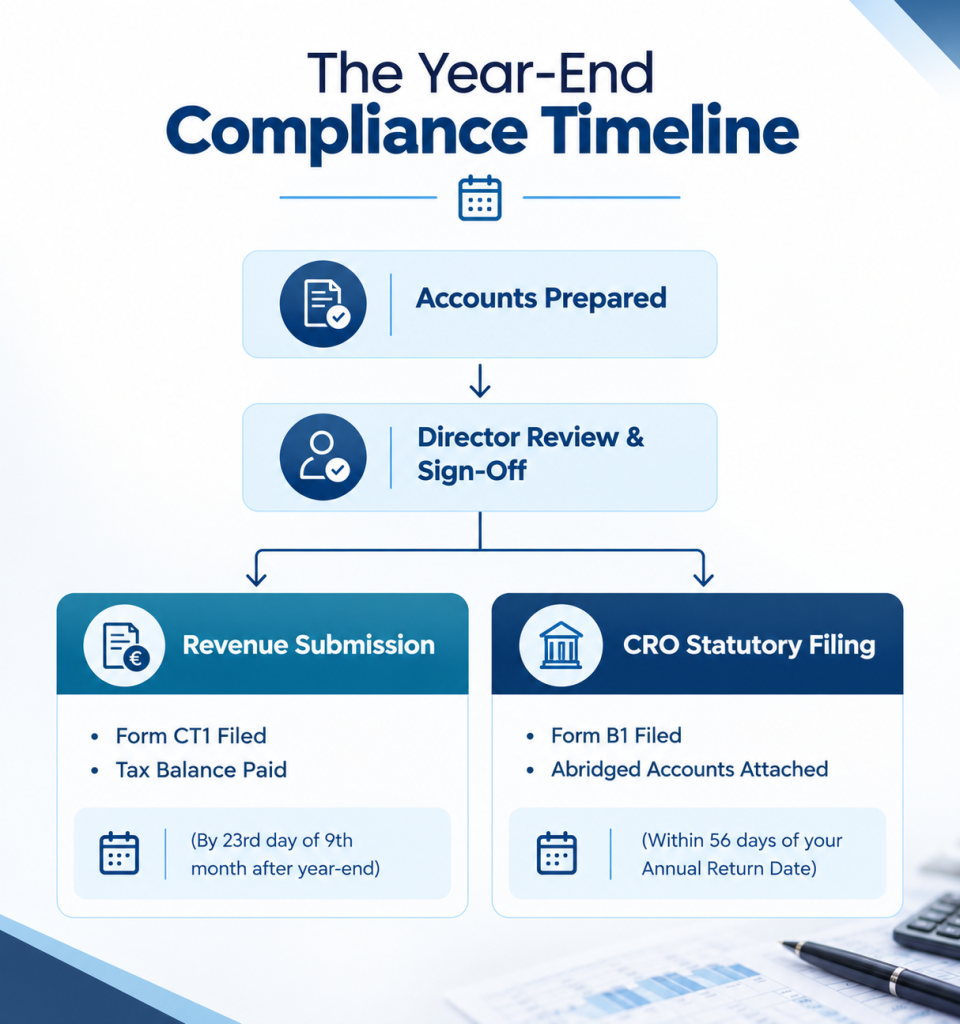
Once your Irish year-end accounts are prepared, the process shifts from bookkeeping to statutory compliance, tax reporting, and formal sign-offs. You must approve the accounts, file them with the Companies Registration Office (CRO), submit your Corporation Tax return (CT1) to Revenue, and pay any remaining tax liabilities.
Review, Approval, and Director Sign-Off
Before any documents are submitted to state agencies, the company’s directors hold the ultimate legal responsibility for the financial statements.
- Directors’ Review: The directors review the financial statements—including the Profit & Loss account, Balance Sheet, and Directors’ Report—to ensure they reflect a true and fair view of the company’s financial health.
- Formal Sign-Off: At least two directors (or the sole director if it is a single-director company) must physically or electronically sign the balance sheet and the directors’ report.
Tax Submission to Revenue (Form CT1)
Your prepared accounts form the foundation of your corporate tax liabilities. Your accountant will adjust the accounting profit for tax purposes to calculate your final corporation tax bill.
- The Filing: You must electronically file a Form CT1 via the Revenue Online Service (ROS).
- The Deadline: The statutory deadline to file the CT1 and pay any outstanding balance is the 23rd day of the 9th month following your financial year-end (e.g., if your year-end is 31 December, your tax return and payment are due by 23 September of the following year).
- Corporation Tax Rates: Your trading income will be taxed at the standard 12.5% rate, while passive or investment income is taxed at 25%.
Statutory Filing with the CRO (Form B1)
Every limited company must file an annual status update with the Companies Registration Office (CRO). From your second annual return onwards, your year-end financial statements must be attached to this filing.
- The Filing: You will submit an annual return (Form B1) online via the CRO CORE portal.
- Filing Exemptions: If your company qualifies as a “Micro” or “Small” entity, your accountant will prepare abridged accounts for the CRO. This allows you to omit the profit & loss account from the public record, protecting your revenue privacy.
- The Deadline: You must file the B1 and attach your accounts within 56 days of your assigned Annual Return Date (ARD). Furthermore, your accounts cannot be made up to a date more than 9 months prior to the ARD.
Conclusion
Properly handling the end-of-the-year closure enables Irish businesses to keep proper accounting records, fulfil legal responsibilities, and sidestep potential compliance problems. By making use of organised year-end accounting checklists, businesses are able to carry out account balancing, determine tax obligations, file statements of account, and comply with the rules of the Revenue and CRO. Early initiation of the year-end closure process allows one to have enough time for error corrections, search for tax-saving possibilities, and arranging bookkeeping documentation.
FAQs
What is included in year-end accounts in Ireland?
Generally, year-end accounts comprise a profit and loss account and balance sheet, along with notes to the financial statements, tax calculations and reconciliations of components like bank balances, wages and salaries, stocks, fixed assets, prepayments and accruals.
When should I start preparing my year-end accounts?
Preferably, you must begin the preparations around two to three months before your financial year comes to an end. For a financial year ending on December 31, the preparations should begin sometime in October or early November.
What is the difference between financial year-end and ARD?
The term ‘financial year-end’ refers to the last day of the accounting period. The Annual Return Date (ARD) refers to the date indicated by the Companies Registration Office (CRO) to submit your annual return and accounts.
When is corporation tax due after year-end in Ireland?
The CT1 and any outstanding Corporation Tax are generally due by the 23rd day of the ninth month after the financial year-end when filing electronically through ROS.
What documents are needed for year-end accounts in Ireland?
Key documents include bank statements, sales and purchase invoices, payroll records, accounts receivable/payable reports, loan statements, fixed asset records, previous financial statements, previous CT1, stock records and capital expenditure records.
What are capital allowances in Ireland?
Capital allowances provide tax relief for qualifying business assets, such as plant, machinery, computers and equipment. For most plant and machinery, the article states that relief is generally 12.5% per year over eight years.