

 Australia
 USA
USA UK
UK Canada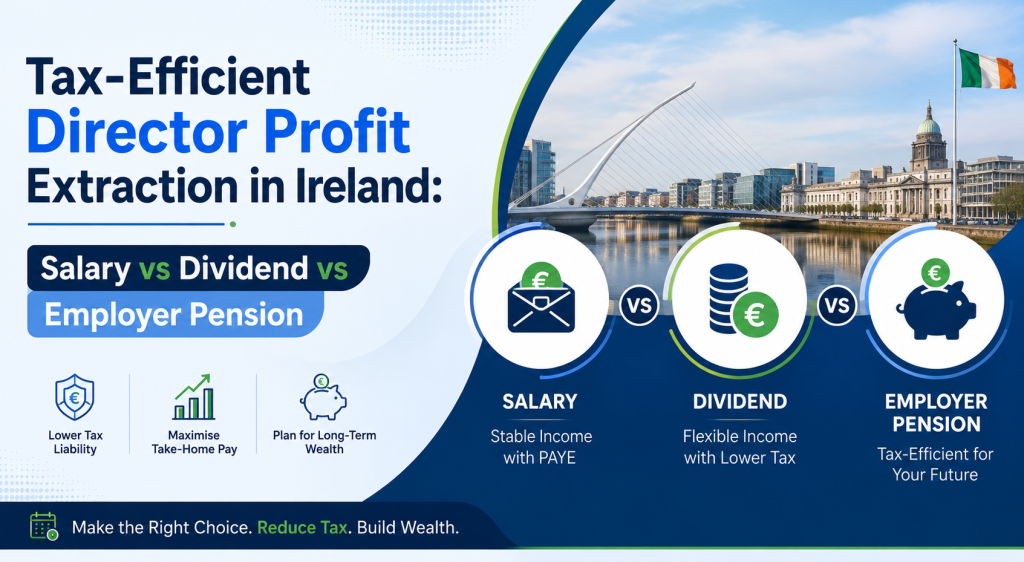




Director profit extraction in Ireland involves choosing between salary, dividends and employer pension contributions, yet many directors assume dividends are automatically the most tax-efficient route. This view is often imported from the UK, but Ireland’s tax system works differently, and the assumption does not hold for most owner-managed companies once the numbers are properly compared. Each extraction route has different tax costs and long-term implications. This guide compares salary, dividends and employer pension contributions side by side using real figures, including corporation tax, PAYE, USC, PRSI and dividend withholding tax. It also covers two important 2026 changes, the higher standard fund threshold and increased entrepreneur relief limit, that can directly affect this year’s profit-extraction strategy.
Salary vs Dividend vs Employer Pension: The Three Extraction Routes at a Glance
For director profit extraction in Ireland, the three main routes are salary, dividends and employer pension contributions. Salaries lower the taxable profits of the company but are liable to PAYE, USC and PRSI. Dividends are paid after tax has been deducted and incur a 25% DWT. Employer contributions to pensions may be deducted for corporation tax but incur PAYE, USC and PRSI.
| Tax & Access Factor | Salary | Dividends | Employer Pension |
| Corporation Tax deductible | Yes | No | Yes |
| Tax on director | PAYE, USC and PRSI at applicable rates | Income Tax and USC; PRSI may apply under self-assessment | No PAYE, USC or PRSI at contribution stage |
| Dividend Withholding Tax | Not applicable | 25% | Not applicable |
| Builds pensionable earnings | Yes | No | N/A — the contribution goes directly into the pension |
| Pension Impact | Can provide relevant earnings for personal pension planning | Does not constitute employment earnings for pension contribution relief | Directly funds retirement benefits, subject to applicable limits |
| Access to funds | Immediate | Immediately, where distributable reserves exist | Generally locked until retirement |
| Best suited to | Regular personal income and building entitlements | Flexible extraction from retained profits | Long-term, tax-efficient retirement planning |
Salary — Mechanics and the Standard Rate Band
Salary is a common starting point for director profit extraction in Ireland because it reduces the company’s taxable profits while providing the director with regular income and pensionable earnings.
- Tax Under PAYE: Salary is generally taxed through PAYE, with income tax, USC and PRSI applying where applicable. Directors who are classified as self-employed for social insurance purposes are generally liable to Class S PRSI. The PRSI classification depends on the director’s ownership, control and employment circumstances.
- Corporation Tax: Salary reduces the company’s taxable profits before corporation tax is calculated.
- Standard rate band: In 2026, the first €44,000 of taxable income for a single person is generally taxed at 20%, with the balance taxed at 40%. Source: Revenue – Tax rates, bands and reliefs (2026). Proprietary directors should note that the Employee Tax Credit does not apply to income directly related to their directorship.
- Pension and PRSI benefits: Salary subject to Class S PRS I can help build a director’s PRSI contribution record, including towards state pension eligibility, subject to the applicable contribution conditions.
For many owner-managed companies, salary can therefore provide a reliable base for remuneration, with dividends and employer pension contributions used alongside it depending on the director’s circumstances and longer-term goals.
Dividends — Mechanics and the “Dividends Are Always Better” Myth
Corporation tax must be deducted before paying dividends. Dividends should not be recognised as deductible expenses when determining taxable income for a business. Even though dividends may be perceived as tax-efficient compensation for workers, this does not mean they work the same way in Ireland.
- Corporation Tax first: Dividends are generally distributed from profit after the relevant Corporation Tax obligations are deducted. Trading income is generally taxed at 12.5%, while non-trading income incurs a tax rate of 25%. Source: Revenue — Corporation Tax
- Dividend withholding tax: Typically, a dividend withholding tax of 25% is deducted when the dividend is paid. Source: Revenue — Dividend Withholding Tax (DWT). The director’s overall income tax on the dividend is computed on the gross dividend amount, minus the dividend withholding tax.
- No earnings for pension: Dividends do not qualify for earnings contributions towards the pension.
- The key misconception: In contrast to the simplified scenario seen in the UK and the US, where dividends are prominently more tax-efficient, it needs to be understood by Irish directors that they have to determine impacts resulting from corporation tax, DWT and personal tax.
Salary can often be the more efficient default for an owner-managed company because it reduces taxable company profits, while dividends do not. However, there is no single most tax-efficient extraction method in Ireland. The optimal mix depends on the director’s personal tax position, company profits, pension capacity and whether the funds are required now or can remain invested for retirement.
The practical takeaway is that dividends can complement salary, but they should not automatically replace it without comparing the actual Irish tax position.
Close-Company Considerations: Many Irish owner-managed companies are classified as close companies and are subject to additional tax rules on certain undistributed income. A 20% surcharge can apply to undistributed after-tax investment and estate income, while qualifying close service companies can face a 15% surcharge on half of their undistributed trading income. Directors should therefore consider the close-company rules when deciding whether to extract, distribute or retain company profits.
Employer Pension Contributions — A Tax-Efficient Long-Term Lever
Employer pension contributions Ireland can be one of the most tax-efficient ways for a company director to allocate surplus company profits towards long-term retirement planning. Unlike salary or dividends, the contribution can be made directly into an approved pension arrangement without PAYE, USC or PRSI applying to the director at the point of contribution.
- Corporation Tax: Contributions made by employers into PRS As 100% limits have been applied from January 1, 2025. Contributions within the limits are exempt from PAYE, USC, or employee PRSI. Excess contributions can incur a benefit-in-kind and may not be claimed for corporation tax purposes.
- Taxes at contribution stage: Under this particular arrangement, there is no impact of PAYE, USC, or PRSI on the director at the time the contribution is made.
- Standard Fund Threshold: In 2026, the SFT value is €2.2 million compared to €2 million in 2025. In 2027, this will increase to €2.4 million, in 2028 to €2.6 million and in 2029 to €2.8 million. When the amount of pension benefit accrued by an individual exceeds SFT, the excess portion becomes chargeable at 40%.
- Auto-enrolment Information: The process of pension auto-enrolment started on 1 January 2026 for employees aged between 23 and 60 who received a salary over €20,000. This is completely independent of the director’s personal pension contribution plans but contributes to total payroll and pension standards.
- Main trade-off: The funds are intended for retirement and generally cannot be accessed like ordinary personal cash; access depends on the pension arrangement and applicable retirement rules.
For directors considering director profit extraction in Ireland, an employer pension should therefore be viewed as a long-term extraction and retirement-planning tool rather than a substitute for income needed today.
Worked Comparison — €100,000 in Extractable Profit, Three Ways
A €100,000 amount of company profit can produce very different outcomes depending on whether it is extracted as salary, distributed as a dividend or used for a qualifying employer pension contribution. The comparison below is illustrative rather than a personal tax calculation. It highlights the key trade-off between immediate personal income and long-term retirement funding.
| Salary | Dividend | Employer Pension | |
| Starting company profit before extraction | €100,000 | €100,000 | €100,000 |
| Corporation Tax | Depends on salary/employer costs | (€12,500) | Generally €0, where treated by Revenue as an ordinary annual contribution* |
| Amount available before personal-level tax | Gross salary, subject to applicable employer costs | €87,500 | Up to €100,000, subject to Revenue accepting the contribution as ordinary and wholly/exclusively for the trade* |
| PAYE / Income Tax | Applicable | Applicable to gross dividend | Generally €0 at contribution stage* |
| USC | Applicable | Applicable | Generally €0 at contribution stage* |
| PRSI | Applicable, where the individual has PRSI-chargeable income | May apply, for proprietary directors/self-employed with relevant income above the threshold | Generally €0 at contribution stage* |
| Dividend Withholding Tax | Not applicable | 25% of gross dividend, credited against final personal tax liability | Not applicable |
| Amount available for spending today | Gross salary less applicable personal taxes | Gross dividend less final personal tax liability; DWT is credited against that liability | €0 from the pension contribution itself |
| Amount allocated to pension | — | — | Up to €100,000* |
| Access to funds | Immediate | Immediate, where a lawful dividend can be paid from distributable profits | Generally restricted until retirement |
*Employer pension contributions require qualification. The amount that can receive the intended tax treatment depends on the pension arrangement, the employee’s remuneration/emoluments, applicable contribution limits and corporation tax deductibility rules. In particular, employer contributions to a PRSA or PEPP are subject to the applicable employer limit, which from 1 January 2025 is generally 100% of the employee’s emoluments. Contributions above the relevant limit can result in a taxable benefit and may not be deductible for corporation tax purposes.
Illustrative assumptions: The €100,000 company profit is assumed to be trading profit subject to the 12.5% corporation tax rate before the relevant extraction. The dividend example assumes no DWT exemption applies. Personal income tax, USC and PRSI on salary or dividends depend on the director’s individual circumstances and are therefore not calculated in this table. The employer pension example assumes the contribution qualifies for the relevant tax treatment.
The Small Benefit Exemption and Other Micro-Levers for Directors
Under Irish tax rules, company directors who are on the payroll can use the Small Benefit Exemption to receive up to five non-cash rewards totalling €1,500 per year completely tax-free. This perk saves on income tax, PRSI, and USC, provided the business purchases the benefit directly rather than using a salary-sacrifice setup.
Small Benefit Exemption (Up to €1,500)
This is one of the easiest ways to take money out of your business without paying any income tax, USC, or PRSI.
- The €1,500 Limit: You can reward yourself with up to €1,500 per year completely tax-free.
- Five-Voucher Rule: You can split this total across a maximum of five individual benefits during the year.
- Strictly Non-Cash: The reward must be given as a voucher, gift card, or physical asset. It can never be cash or an ATM-enabled card.
- The Trap: If you go over the €1,500 limit by even one euro, the entire amount becomes fully taxable, not just the extra bit. Your company must buy the vouchers directly and report them to Revenue right away.
Spouse or Partner Salary
If your spouse or partner does genuine, active work for your business, putting them on the company payroll is a great way to lower your household’s overall tax bill.
- Market-Rate Only: You must pay them a fair, standard wage for the actual work they do (like managing social media, doing paperwork, or handling customer service).
- Tax Efficiency: This strategy allows your household to utilise their personal tax credits and lower 20% tax rate band. This keeps thousands of euros in your home that would otherwise be taxed at your higher director rate of up to 52%.
Structured Benefits-in-Kind (Health Insurance)
A Benefit-in-Kind (BIK) is a perk you get from your job that is not part of your cash salary, like private health insurance.
- Company Paid: Your limited company can pay directly for your health insurance premium. This is a fully deductible business expense, which helps lower your company’s corporation tax bill.
- How it is taxed: While you will still pay personal income tax on the value of the perk, the company does not have to pay Employer PRSI (which is usually an extra 11.05%) on health insurance. This makes it a much cheaper way to provide healthcare compared to paying for it out of your own pocket after taxes.
Building a Combined Strategy for Tax-Efficient Director Profit Extraction Ireland
A combined strategy for tax-efficient profit extraction in Ireland requires balancing three primary pillars: salary, pensions, and dividends. Relying on just one method often leads to a high tax bill—up to 52% in personal income tax, Universal Social Charge (USC), and Pay As You Earn (PAYE).
The primary takeaway is that you should draw a modest salary to cover baseline living costs and protect state benefits, use employer pension contributions to extract the largest chunk of corporate wealth tax-free, and use dividends secondarily to manage short-term cash needs.
Baseline Salary
Set your salary to €44,000, which matches the single-person standard rate cut-off point. This fully utilises your 20% tax band and personal credits while keeping the business’s salary expenses 100% tax-deductible. It avoids the 40% higher bracket but secures Class S PRSI (4%) to maintain your State Pension record.
Selective Dividends
Dividends face double taxation because they are paid from net profits after 12.5% corporation tax. However, they are highly effective for income splitting with a lower-earning or non-working spouse who has unused tax bands. They bypass PRSI and USC charges, but the company must withhold 25% Dividend Withholding Tax (DWT) at the source.
Employer Pensions
Direct all surplus profits into employer pension contributions. They bypass income tax, USC, and PRSI at entry while remaining fully deductible for the company.
- PRSA Limit: Company contributions to a PRSA are capped at 100% of your employment salary.
- Employer Pension: Use an employer pension scheme for massive, immediate lump sums to back-fund historic years of service.
- The SFT Cap: Carefully monitor total growth against the €2,000,000 Standard Fund Threshold to prevent a 40% penalty tax at retirement.
Micro-Levers
Automate minor daily expenses completely tax-free:
- Vouchers: Claim up to €1,500 annually via two retail vouchers under the Small Benefit Exemption.
- WFH Allowance: Pay yourself €3.20 per day tax-free for home office electricity, heating, and broadband. Source:
- Travel: Use official Civil Service mileage rates for legitimate business travel. [3, 4, 5]
Material Changes & Exit Planning
Never bonus yourself out of a sudden profit spike, as it triggers a 52% top tax bracket. Source: Route it to a pension or retain it in the business, but watch out for the 20% closely held company surcharge on unextracted passive investment income. Long-term, plan for Entrepreneur Relief (10% CGT up to €1m) or Retirement Relief to exit or liquidate tax-free.
When to Review Your Strategy for Tax-Efficient Director Profit Extraction
You should review your strategy for direct profit extraction in Ireland at least once a year, but specifically before the end of the tax year to maximise your savings. Because tax laws, corporate profits, and personal income needs change constantly, a set-and-forget approach will cost you money.
Key Times to Review Your Strategy
- Before the Tax Year End: This is the most critical time. You must check your strategy a few months before December 31 so you have time to make dynamic pension contributions or clear out tax-efficient dividend bands.
- Changes in Government Taxation Policies: Whenever a new government budget is released, taxation rates, pension limits, and dividend allowances are amended. Therefore, you must re-register your plan as soon as these announcements are made.
- Changes in Corporate Income: In case of extreme success or a setback in business, the company will need to quickly modify its withdrawal approach. Higher profit generation will entail additional preparations in order to save yourself from large corporate taxation.
- Changes in Personal Life: When you purchase a new home, marry, or get ready for retirement, you will require money to take care of these events. Hence, your plan should be adjusted so that you can have the right amount of money but not exceed the tax brackets.
Common Mistakes Directors Make When Extracting Profits from Their Company
Directors often make costly mistakes when taking money out of their company by failing to separate personal and business funds, miscategorising payments, or ignoring tax rules. These errors can lead to unexpected tax bills, severe financial penalties, or legal trouble with tax authorities like Ireland’s Revenue Commissioners.
- Assuming dividends are automatically more tax-efficient than salary: Directors should compare the actual Irish tax consequences, including corporation tax, income tax, the Universal Social Charge (USC), pay-related social insurance (PRSI) and dividend withholding tax.
- Relying on dividends alone: Dividends do not constitute employment income, but in Ireland they are treated as part of your total taxable income, meaning they face income tax at your standard (20%) or higher (40%) rate alongside the Universal Social Charge (USC) and Pay-Related Social Insurance (PRSI) where applicable.
- Overlooking employer pension contributions: Some directors treat pension contributions as a separate retirement decision rather than considering them as part of their overall profit-extraction strategy.
- Failing to monitor the standard fund threshold: Directors making substantial pension contributions should track their projected retirement benefits against the applicable standard fund threshold, particularly as the threshold is scheduled to increase through 2029.
- Treating the extraction mix as a one-time decision: Salary, dividends and employer pension contributions should be reviewed periodically as company profits, personal circumstances, pension capacity and tax rules change.
Conclusion
The most tax-efficient strategy for director profit extraction in Ireland is rarely about choosing salary, dividends or employer pension contributions in isolation. The better approach is to combine them based on your company’s profits, personal tax position, pension capacity, cash-flow needs and long-term goals. Salary provides regular income and pensionable earnings; dividends offer flexibility, while employer-contributed pension contributions can facilitate tax-efficient retirement. However, as the tax regulations and thresholds keep changing, directors must re-evaluate their withdrawal strategy regularly rather than relying on assumptions. A customised number-based solution allows one to balance between immediate income and wealth generation in the long term.
FAQs
Is salary or dividends more tax-efficient for Irish directors?
Neither is automatically better. The right choice depends on your tax position, company profits and cash needs.
What is the standard fund threshold, and why does it matter for directors?
The standard fund threshold for 2026 is €2.2 million. Pension benefits above it can face a 40% tax charge.
Are employer pension contributions really tax-free?
They can be tax-free at the contribution stage, with no PAYE, USC or PRSI generally applying, subject to the relevant limits and conditions.
Do dividends avoid PRSI?
Not always. PRSI may apply depending on the director’s circumstances.
Can a director combine salary, dividends, and pension contributions?
Yes. Combining all three can balance regular income, flexible cash and long-term retirement planning.
How does the 2026 Entrepreneur Relief change affect profit extraction planning?
The increased relief limit can make exit planning more tax-efficient, so directors should consider it alongside their profit-extraction strategy.