

 Australia
 USA
USA UK
UK Canada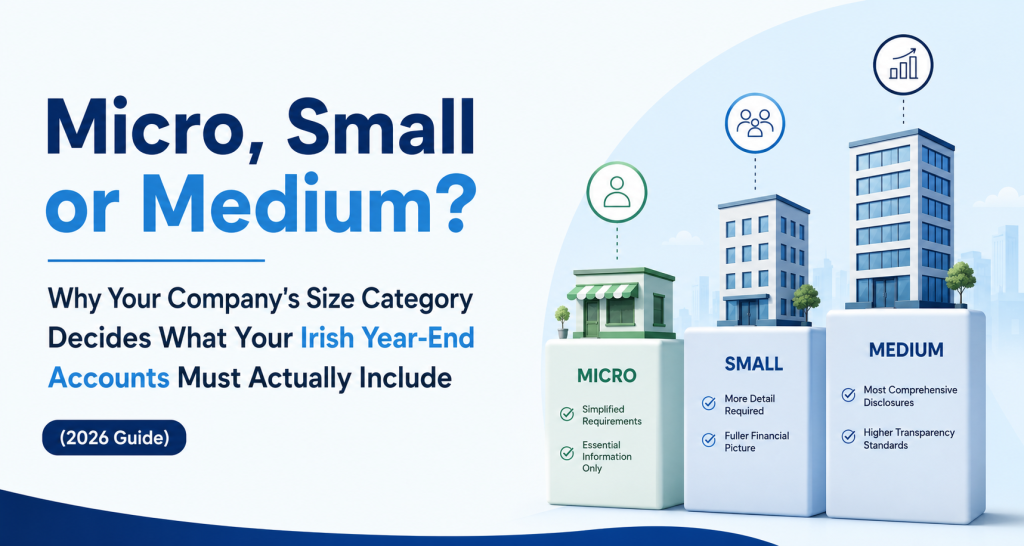




Two Irish companies can post almost identical turnover figures this year and still face completely different year-end filing obligations. One might file a two-page abridged balance sheet with no directors’ report and no public profit and loss account. The other might be required to prepare full financial statements and a directors’ report and arrange a statutory audit. The difference usually isn’t the industry, the accountant, or the software. It’s the size category the company falls into under the Companies Act 2014 — and since July 2024, that category has shifted for a meaningful number of Irish businesses.
If you’ve read our guide on year-end accounting costs in Ireland or worked through our year-end accounting checklist, you’ve likely seen the word “complexity” used to explain why one company’s accounts take longer or cost more to prepare than another’s. This post explains what actually creates that complexity: your company’s size classification and the specific legal thresholds — recently increased — that decide it.
The Three Categories and Current 2026 Thresholds
Irish company size categories are set out in sections 280A to 280I of the Companies Act 2014, and they were significantly revised by the European Union (Adjustments of Size Criteria for Certain Companies and Groups) Regulations 2024 — SI No. 301 of 2024. The table below reflects the thresholds currently in force.
| Category | Balance sheet total | Net turnover | Average employees |
| Micro | ≤ €450,000 | ≤ €900,000 | ≤ 10 |
| Small | ≤ €7.5 million | ≤ €15 million | ≤ 50 |
| Medium | ≤ €25 million | ≤ €50 million | ≤ 250 |
| Large | Exceeds medium thresholds | Exceeds medium thresholds | > 250 |
Two things about this table trip up business owners more often than anything else.
First, you don’t need to meet all three criteria — you need to meet two out of the three (balance sheet total, net turnover, average number of employees). A company with high turnover but a modest balance sheet and a small headcount can still land in a lower category than its revenue alone would suggest.
Second, and this is the detail most competitor articles skip entirely: you need to meet those two criteria in both the current financial year and the preceding financial year (unless it’s your company’s first financial year). A single good or bad year doesn’t automatically move you into a new category. The Companies Registration Office and the Act itself build in this two-year test specifically so that one-off spikes or dips in turnover don’t force a company to keep switching its reporting framework every twelve months. In practice, this means you can’t just glance at this year’s management accounts and assume you know your category — you need last year’s numbers on the table as well.
Why This Changed in 2024 (and Why It’s Worth Rechecking)
The current thresholds exist because of SI No. 301 of 2024, signed into law on 19 June 2024 and effective from 1 July 2024. The regulation transposed an EU-wide inflation adjustment — Delegated Directive (EU) 2023/2775 — into Irish law, increasing the balance sheet and turnover thresholds for micro, small, medium and large companies by approximately 25%. The stated purpose was straightforward: inflation had eroded the real value of thresholds set years earlier, and without an adjustment, companies were being pulled into heavier reporting and audits. obligations simply because their nominal turnover had risen with prices, not because their underlying business had grown in any real sense.
The changes apply to financial years beginning on or after 1 January 2024, and companies with a 2023 year-end were also given the option to apply the new thresholds early. Critically, the employee count thresholds were left untouched: 10 for micro, 50 for small, and 250 for medium. Only the balance sheet and turnover figures moved.
The practical effect is this: a company that was correctly classified as “small” under the pre-2024 rules may now qualify as “micro”. A company that was “medium” may now be “small”. If your bookkeeper, accountant, or internal finance team hasn’t specifically re-tested your classification since mid-2024, it’s worth doing that check before this year’s accounts are prepared, not after. Getting the category wrong doesn’t just risk a filing rejection — it can mean preparing a fuller set of accounts (and paying for a fuller audit or accounts preparation service) than the law actually requires of you.
What Actually Changes in Your Accounts at Each Tier
This is the part that most threshold explainers – including the ones published by several accounting firms and compliance platforms – stop short of explaining. Knowing which box you tick is only useful if you know what that box actually requires you to file. Here’s the practical breakdown.
Micro-companies (FRS 105)
Microcompanies are required to report in accordance with the Financial Reporting Standard (FRS) 105, the Financial Reporting Standard for the Micro-entities Regime. The requirements are deliberately minimal:
- An abridged balance sheet is submitted to the CRO, while a profit and loss account is not required to be submitted to the public.
- A directors’ report is not required. Under section 325 of the Companies Act 2014, as amended by section 41 of the Companies (Accounting) Act 2017, micro companies are exempt from preparing one, provided certain limited disclosures (relating to the acquisition or disposal of a company’s own shares under section 328) are still made where relevant.
- Micro companies are exempt from most of the standard Notes to the Financial Statements requirements, specifically the disclosure obligations under Sections 314, 317, 318, 319, 322 and 323(1) of the Companies Act 2014.
- If the exemption from complying with the abridgement is being used, a statement by a director confirming the use of section 352 and the proper preparation of the statements under section 353 must be included on the balance sheet.
Small Companies (FRS 102 Section 1A)
Small companies report under FRS 102, applying the reduced disclosure regime in Section 1A. The obligations step up from micro but are still meaningfully lighter than medium- or large-company reporting:
- Small companies can choose to file abridged financial statements under sections 352 and 353 of the Companies Act 2014, but with more disclosure notes required than a micro company – the abridgement exemption for a small company still requires notes that micro companies are exempt from.
- A directors’ report is generally still required for small companies (the directors’ report exemption under section 325 is specific to micro companies, not small companies).
- Audit exemption is available to qualifying small companies, but it’s a separate test with its own conditions — size alone doesn’t automatically confer it.
Medium Companies
Medium companies lose most of the simplifications available to micro and small companies:
- Full financial statements are required, including a full profit and loss account and balance sheet prepared in accordance with the applicable standard (typically full FRS 102).
- A directors’ report is mandatory.
- There is no automatic audit exemption. Once other qualifying conditions for audit exemption cease to apply (which is common once a company reaches medium scale), a statutory audit becomes a firm requirement.
The pattern across all three tiers is consistent: the smaller your category, the less you’re required to disclose publicly and the fewer statutory reports you need to prepare — but each step down in reporting burden comes with its own specific legal test, not just a general “you’re small enough” assumption.
The Audit Exemption Connection
Meeting the size thresholds for micro or small company status is the entry condition for audit exemption — it opens the door, but it isn’t the whole test. A company also needs to meet conditions relating to filing its annual return on time, not being part of a group that requires a group audit, and not falling into a category of company (such as certain regulated entities) that’s excluded from the exemption regardless of size. Missing an annual return deadline in the relevant period, for example, can disqualify an otherwise-eligible small or micro company from claiming audit exemption that year, even though its balance sheet and turnover comfortably sit within the micro- or small-company thresholds.
If you’re weighing up whether your company can actually avoid a statutory audit this year, our Audit Exemption in Ireland guide walks through those additional conditions in full. This article is deliberately focused on the size classification question that sits underneath it.
FRS 105 Periodic Review — Effective for Periods Beginning 1 January 2026
FRS 105 is reviewed periodically by the UK and Ireland’s Financial Reporting Council, roughly every five years. The second periodic review — Periodic Review 2024 — was finalised in March 2024 and takes effect for accounting periods beginning on or after 1 January 2026. For microcompanies with a calendar year-end, that means the accounts you’re preparing for the 2026 financial year are the first to fall under the revised standard.
The biggest adjustment is a new model for revenue recognition that closely mirrors the IFRS 15 principles and differs from the previous model in FRS 105. There are also changes to inventory cost for accounting service providers. In a separate document in February 2026, the FRC published additional, more limited amendments to FRS 105 on an adapted format of the balance sheet and profit and loss statement, which will not apply to most year-ends in 2026 but will instead take effect on accounting periods commencing on or after 1 January 2027. It’s important to be aware of their existence, but the only one that will impact your accounts this year will be the periodic review in March 2024.
If your financial year has started on or after 1 January 2026 and you report under FRS 105, you may want to discuss this change with the accountant preparing your accounts, as it could impact how your income is recognised (especially if you invoice in stages, take deposits or provide long-term service contracts).
Common Mistake: Assuming Your Category Never Changes
The single most common assumption we see trip up business owners isn’t about the thresholds themselves — it’s the belief that once you’re classified as “small”, you stay “small” indefinitely. You don’t. A growing company, adding employees, or increasing the balance sheet size via retained earnings or the acquisition of assets can step over the threshold without anyone within the company realising it until the accountant retests the classification at year-end.
Because the classification test looks at two consecutive years, a company can cross a threshold in one year and not “trigger” a category change immediately, but if the growth holds for a second year, the category changes, and with it the filing requirements, the potential loss of audit exemption, and possibly the need for a directors’ report where none was required before. The safest practice is to check your category at every year-end, not just once when the company is incorporated or once when an accountant first sets up your compliance pack.
How Aone Approaches This
Confirming a client’s size category — and therefore the correct reporting framework and filing requirements — is a standard first step in how Aone Outsourcing Solutions prepares year-end accounts for Irish clients, not something checked in passing partway through the process. Because the 2024 threshold increase moved a real number of businesses between categories, we treat this as a re-test at every year-end rather than a one-off assumption carried forward from a prior year’s accounts.
That means checking balance sheet, turnover and average employee numbers for both the current and preceding financial year before deciding what your accounts need to include, whether a directors’ report is required, and whether audit exemption is genuinely available to you.
Ready to Confirm Your Company’s Category?
If you’re not certain which category your company currently falls into — or whether the 2024 threshold changes have shifted you into a lighter reporting regime — it’s worth confirming before your next year-end accounts are prepared. Book a year-end accounting review call with Aone Outsourcing Solutions, and we’ll walk through your figures against the current thresholds together.
Frequently Asked Questions
How do I know what size category my company falls into?
Compare your balance sheet total, net turnover, and average number of employees for the current and preceding financial year against the thresholds in sections 280A–280I of the Companies Act 2014. You need to meet two of the three criteria in both years to qualify for micro, small, or medium status; if you exceed the medium thresholds, you’re classified as a large company.
Does being a micro company mean I don’t need an audit?
Not automatically. Meeting the micro-company-size thresholds makes you eligible to be considered for audit exemption. Still, you also need to meet separate conditions — including filing your annual return on time and not belonging to a group that requires a group audit. Size alone doesn’t guarantee the exemption.
Do micro-companies still have to file a directors’ report?
Generally, no. Under section 325 of the Companies Act 2014, as amended by the Companies (Accounting) Act 2017, micro companies are exempt from preparing a directors’ report, provided certain limited disclosures relating to the acquisition or disposal of the company’s own shares are made where applicable.
Can my company’s size category change from one year to the next?
Yes. Classification is based on meeting the relevant thresholds in both the current and preceding financial years, so a change in your turnover, balance sheet, or headcount that holds for two consecutive years can move you into a different category — with different filing and audit requirements attached.
What is FRS 105, and how is it changing in 2026?
The Financial Reporting Standard 105 is the accounting standard for the Micro-entities Regime — which applies to companies that fall within the scope of the Micro-entities Regime as defined in the Companies Act 2014. Its second periodic review was completed in March 2024 to be effective for accounting periods beginning on or after 1 January 2026 and includes a revised revenue recognition model consistent with the principles of IFRS 15, among other changes.