

 Australia
 USA
USA UK
UK Canada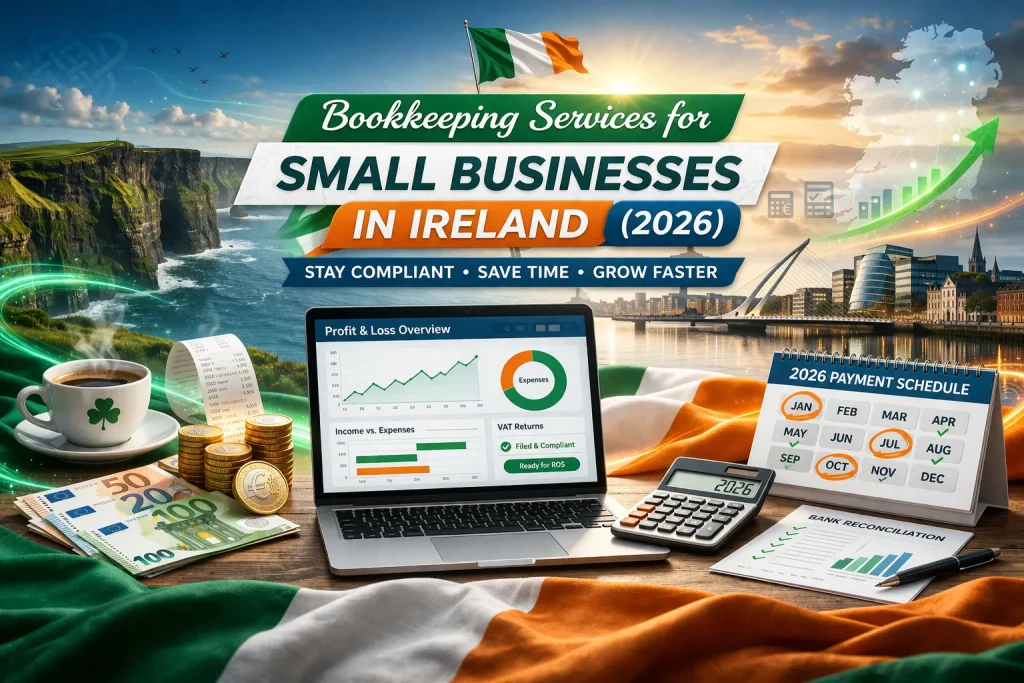



Managing a small business in Ireland needs more than the simple recording of income and expenses. From record-keeping of invoices and receipts to tracking cash flow, preparing VAT records, and being ready for the revenue requirements, bookkeeping – in fact, accurate bookkeeping – is the cornerstone to keeping your business financially healthy. This becomes more important in countries like Ireland, where SMEs (small & medium enterprises) account for 99.8% of active enterprises in the country, according to the Business in Ireland 2023 report of the Central Statistics Office.
For small business owners, it is quite common to manage their books on their own; however, keeping the books up to date can become a complicated and time-consuming task as the business scales up. In such a case, most of the time, small business bookkeeping in Ireland can be managed internally by business owners by hiring a professional bookkeeper or outsourced to specialists.
But questions like “When does professional support make financial sense?” and “What is the cost of bookkeeping in Ireland in 2026?” Create a state of confusion in the minds of SME owners about whether to DIY or outsource bookkeeping services due to financial restrictions.
Well, if you are an Irish business owner stuck in this situation, this guide can really help you, as in this guide we discuss the service costs, benefits and key considerations for choosing the right bookkeeping solution for your small business in Ireland.
What Are Small Business Bookkeeping Services?
Bookkeeping is the orderly system of recording all financial transactions of a business: sales made, expenditures incurred, invoices issued, and bank transfers carried out.
Bookkeeping services for small businesses normally include:
- Documenting the daily income and expenditure.
- Bank reconciliation
- Management of accounts payable and receivable.
- Preparation and filing of VAT returns.
- Payroll and PAYE.
- Management accounts and financial statements.
- CRO filings on small companies.
It’s important to differentiate between bookkeeping and accounting. Bookkeeping is concerned with the precise, continuous recording of transactions. That data is then processed in accounting, where it is interpreted, and as such, financial statements are prepared, tax planning advice is given, and prospective guidance is offered. Both are important, but the crucial part is the bookkeeping.
In Ireland, bookkeeping providers would be in-house bookkeepers, freelance bookkeepers, accounting firms, and outsourced specialists. Bookkeepers can be professional and hold qualifications from CPA Ireland, the Institute of Accounting Technicians in Ireland (IATI), or the International Association of Bookkeepers (IAB).
Essential Bookkeeping Terms Every Irish Business Owner Should Know
Bookkeeping comes with its own terminology, and understanding these terms can be handy in making informed decisions for your Irish SME as a business owner. Some of the essential bookkeeping terms that Irish entrepreneurs should be familiar with include the undermentioned terms: assets (what you own), liabilities (what you owe), accounts receivable (money that your clients owe you), and accounts payable (bills owed to vendors) are the most prominent terms in bookkeeping. Apart from this, it is also better to be informed about other local business terms like VAT (Value Added Tax), PRSI (Pay-Related Social Insurance), and revenue compliance.
Here are some other essential bookkeeping terms that every Irish small business owner must know.
Core Financial Terms
- Assets: This refers to the financial possessions that you have in your business, which consist of cash resources, assets, buildings, automobiles, and stock inventory.
- Liabilities: It includes any debt or financial obligations that exist in your organisation, such as loans to finance your business, overdue bills, and payments due to suppliers.
- Equity: It determines the amount of equity of the business, calculated by deducting total liabilities from the total assets value.
- Revenue: The money earned by your business through sales before deducting operating expenses.
- Expenses: The expenses your business needs to keep functioning, including things like rent, wages, utilities, insurance, software, and office supplies.
- Bank Reconciliation: The term for the process of following your business bank statement and comparing it to your bookkeeping records in order to find errors, repeats, or missing transactions.
- Chart of Accounts: A list of your business income and expenses, assets, liabilities, and owners’ equity.
- General Ledger: Where all your business records and transactions are first noted.
- Profit & Loss Statement: A report about business financial affairs, listing income, expenses and showing profit or loss after a period of time.
- Cash Basis: A system of bookkeeping that records income only when money is received and expenses only when paid.
- Accrual Basis: A system that records income and expenses when they are incurred, regardless of the timing of payment.
Cash Flow and Credit
- Accounts Receivable: Funds that are owed by the clients and customers to your business for the products or services delivered by your entity.
- Accounts Payable: Money that is owed by your company to its suppliers and creditors that provided goods or services for sale to your business.
- Cash Flow: Money entering and exiting the business. Healthy cash flow helps a business meet its daily requirements even if its revenues vary.
Irish Tax and Compliance Terms
- VAT (Value Added Tax): The tax for consumption which applies to most goods and services that can be found and collected in Ireland. VAT-registered businesses usually collect VAT and remit it to the Revenue Department.
- VAT Return: The report provides important VAT information that can be reviewed by Revenue in deducting VAT for the corresponding period.
- ROS (Revenue Online Service): The online service established by Revenue for the purposes of filing tax returns, making tax payments and other tax-related services.
- PAYE (Pay As You Earn): The system used to deduct income tax and PRSI (Pay-Related Social Insurance) as well as USC (Universal Social Charge) from salaries of employees and report it to Revenue.
- Tax Clearance Certificate: An electronic confirmation from the Revenue that states that the taxpayer’s tax affairs are in order when tax clearance is needed.
- Relevant Contracts Tax (RCT): A withholding tax that is applied to select payments made by principal contractors to subcontractors in selected industries, like construction.
- PRSI & USC: PRSI is a contribution to social insurance that helps to support Ireland’s social welfare system, while USC is a type of tax. Employers may need to account for both in their payroll.
- Revenue Commissioners: This is a group run by the Irish government. They are responsible for the administration of tax and customs related to VAT, income tax, corporation tax, PAYE, and so on.
- Double-Entry Bookkeeping: It is a type of bookkeeping system that keeps a complete record of every transaction in two or more accounts with certain entries in both debit and credit.
What Records Must You Keep by Law in Ireland?
Keeping proper business records or small business bookkeeping Ireland is not just a good financial practice in the country; it is a legal requirement too. Under Section 886 of the Taxes Consolidation Act 1997, businesses have to keep records of their financial records of tax returns, including records of revenue & expenses, assets & liabilities and relevant capital transactions. You must also store supporting “linking documents” like bank statements, invoices, and receipts to back up your tax returns.
Tax and Financial Records
- Income Logs: Sales registers, documents of cash receipts and bills of customers.
- Expense Logs: Purchase registers, invoices from suppliers, documents of cash receipts and receipts for business expenses.
- Banking Records: Records of banks, building societies, credit cards, merchants’ accounts and cheque stubs.
- Asset Details: Documentation about the purchases/sales of property.
Company Secretarial & Statutory Books (Limited Companies Only)
- Register of Members: Availability of the details of shareholder information, shareholdings, and transfer of shares.
- Register of Directors and Secretaries: Full name, domestic address, and the date at which the individual is appointed.
- Register of Beneficial Owners: Information about individuals who are entitled to ownership and voting rights exceeding 25%.
- Records of meetings: Access to the record of board meetings, AGMs of the company, and the resolutions passed.
Employment and Payroll Records
- Employee details: Full names, addresses, PPS numbers, and job title.
- Payroll Records: Gross amount and payment details, payroll journals, and details of PAYE/PRSI deductions.
- Working Hours: Clock input, or timesheet input stating hours worked and breaks taken, as well as the leaves and holidays taken.
Health, Safety & Data Protection (GDPR)
- GDPR (General Data Protection Regulation) ROPA (Rules of Processing Activities): Records that describe the manner in which you acquire, make use of, safeguard, and handle personal information.
- Health & Safety: Records of accidents, health and safety policy statements, risk evaluations, educational records, etc.
Record Retention Timelines
Irish law enforces strict rules on how long you must retain your business records before destroying them.
| Record Type | Mandatory Retention Period | Legal Authority |
| Tax & Accounting Records | 6 years from the end of the relevant tax year | Revenue Commissioners |
| Employee & Payroll Records | 6 years after employment terminates | Workplace Relations |
| Health and Safety Logs | 10 years minimum | Health and Safety Authority |
| Statutory Books & Board Minutes | Permanently (lifetime of company) | Companies Act 2014 |
| EU or Government Grant Records | 10 years | Grant Funding Body rules |
Pay Attention: Failure to maintain proper accounting records is a criminal offence in Ireland, and company directors can be held personally liable.
Bookkeeping Cost for Small Business in Ireland 2026
The cost for small business bookkeeping in Ireland depends on choosing a bookkeeping provider, the size of your business, and the amount and the complexity of your financial operations. The hourly bookkeeping charges for a small-sized business in Ireland can range from €25 to €50 on demand, although for monthly packages, the fee can go up to €400+.
Total expenses for the year can differ substantially depending on different factors, ranging from being a self-employed individual or limited liability company to the number of transactions taking place and whether one avails any additional services, such as VAT or payroll.
The table below provides estimated bookkeeping costs while showing the key factors that can influence the final price:
| Service Type | Estimated Cost | Best For | Cost Driver | Why It Moves the Price |
| Basic hourly bookkeeping | €25–€50/hour | Very small, simple businesses | Transaction volume and hours required | More sales, purchases, invoices, and bank transactions mean more processing time. |
| Part-time in-house bookkeeper | €300–€600/month | Growing SMEs needing regular support | Hours, payroll, VAT, and transaction volume | More working hours and additional responsibilities increase the monthly workload. |
| Full-time in-house bookkeeper | €25,000–€45,000/year | Larger businesses with high transaction volumes | Salary, benefits, workload, and complexity | A full-time employee involves salary and employment costs, while complex financial operations require more expertise. |
| Monthly outsourced package | €95–€500/month | Most small businesses | Transactions, bank accounts, VAT, payroll, e-commerce | Higher transaction volumes, multiple accounts, VAT returns, payroll, and e-commerce reconciliation require additional work. |
| Annual all-in package | €700–€3,000+/year | Sole traders to small limited companies | Annual transactions, VAT, accounts complexity, and service scope | More financial activity and additional services can increase the amount of work required throughout the year. |
Note: Costs are approximate and can vary depending on the provider, business size, location, accounting software, transaction volume, and scope of work.
Do-It-Yourself vs. Outsourcing: Are You Right?
When Does DIY Make Sense?
Self-management of books may be effective when you are a sole trader or freelancer with low transaction volume, low financial literacy, and a quality cloud accounting solution. Nevertheless, to file your taxes, you should have your accountants review your yearly accounting to ensure you do not make mistakes.
When to Hire Professional Bookkeeping Services?
DIY bookkeeping begins to cost you more than it saves as your business grows. When to consider a professional for the following:
- You are spending an average of a few hours a week on your books.
- You have staff and have to deal with the PAYE and payroll.
- You are registered or registering for VAT.
- You are a small company with a CRO responsible for your operations.
- You are intending to grow, or you are looking to get finance.
The True ROI of Outsourcing
Outsourcing is not an entirely cost-based decision; it is a value. Outsourcing businesses usually depend on hours per week, minimise costly mistakes, enjoy real-time financial visibility via cloud solutions, and tap into an expert in VAT regulations and revenue modifications without the additional expense of a full-time employee.
Essential Bookkeeping Tasks Every Small Business Must Do
Maintaining accurate bookkeeping involves a range of regular tasks throughout the week, month and year. Following a regular bookkeeping schedule helps SMEs in Ireland to keep their financial records up to date and accurate, monitor cash flow and stay on top of their tax obligations.
Weekly Bookkeeping Tasks
- Record all sales and income
- Log purchase invoices and receipts
- Record cash receipts and payments
- Check outstanding invoices and follow up on overdue payments
- Keep supporting documents organised for all transactions
Monthly Bookkeeping Tasks
- Reconcile all business bank and credit card accounts
- Process payroll and submit PAYE modernisation information to Revenue
- Review accounts receivable and follow up on outstanding invoices
- Check accounts payable and upcoming supplier payments
- Review a basic profit and loss statement to understand monthly performance
- Ensure bookkeeping records are complete and up to date
Quarterly Bookkeeping Tasks
- Prepare and submit VAT returns according to your assigned VAT taxable period
- Review management accounts and key financial figures
- Compare actual income and expenses with your budget or forecasts
- Identify unusual changes in revenue, expenses, or cash flow
- Review financial performance and adjust budgets or spending plans where necessary
Yearly Bookkeeping Tasks
- Prepare your end-of-year accounts and supporting financial records
- Complete the relevant Income Tax return, such as Form 11 where applicable
- Prepare and file the relevant Corporation Tax return (Form CT1) for companies subject to Corporation Tax
- Complete the company’s annual return with the Companies Registration Office (CRO), where applicable
- Review and organise financial records and supporting documents
- Retain relevant business and tax records for the required period, which is generally six years under Revenue’s record-keeping requirements
Top Small Business Bookkeeping Software
Small businesses have revolutionised their bookkeeping with cloud-based accounting software. By automating repetitive tasks, minimising errors, and providing you with real-time financial visibility, the right platform can help. Here are the best bookkeeping software for small businesses:
| Software | Best For | Features | Ease of Use | VAT Support | Pricing |
| Xero | SMEs | Cloud-based automation | Easy | Yes | ~€15/month |
| QuickBooks | Small businesses | Better reporting, invoicing | Easy | Yes | ~€12/month |
| Sage | Accounting Firms | Advanced features, automation | Medium | Yes | ~€14/month |
| FreeAgent | Freelancers, Sole traders | Simplicity | Easy | Yes | ~€12/month |
Key Features to Look For
- Irish VAT reporting, RTD, and Intrastat in EU trading.
- Bank feeds that automatically import transactions from your Irish bank account.
- Mobile app receipt capture.
- Multi-user access to your accountant or bookkeeper.
- Payroll module dealing with PAYE Modernisation reporting.
Tips for Getting the Most from Your Software
- Balancing your bank account at least once a week prevents it from accumulating.
- Automatically classify recurring transactions using bank rules.
- Provide your bookkeepers with access to the platform instead of having them export files and mail them.
How to Automate Your Bookkeeping?
The process of automating bookkeeping can save quite a lot of time on repetitive bookkeeping tasks, all with the help of human oversight by hiring manual bookkeeping services. Current cloud accounting software facilitates the completion of many processes that are automated, from downloading bank activity to sending bill reminders and collecting receipts.
Here are some of the most useful ways to automate your bookkeeping:
- Set up Bank Feeds: This is achieved by linking your bank accounts with your accounting software, saving you the headache of creating sales records manually.
- Create Bank Rules: Rules can be set for all recurring payments, including those for rent, subscriptions, utilities, or supplier payments, making categorisation of those transactions automatic.
- Use Receipt Scanning: This way, the receipts, whether they are scanned or photographed, will be analysed and will provide you with the needed information thanks to the technology of OCR (optical character recognition).
- Automate Invoicing: This function allows you to automate your billing process by sending invoices to the same clients repeatedly, according to your schedule.
- Set up Payment Reminders: With automatic reminders, you will easily notify your customers about their overdue invoices without having to prompt them each time about the outstanding payments.
- Integrate Payroll Processing: Payroll processing makes sure your payroll data is properly input into your accounting records, thus preventing redundant bookkeeping.
However, automation does not eliminate the need for human oversight. Software may be able to process vast amounts of data but are not necessarily able to understand their context. For example, a payment can be processed incorrectly as a result of a supplier changing its reference or a business activity changing its nature. Regular analysis of automated entries and accounts helps identify problems before they have any negative impact on the financial outcome.
The best approach for small companies in Ireland is the combination of automation and human professionals. With this approach, routine bookkeeping is done in an efficient manner, while a bookkeeper or an accountant focuses on the exceptions, accuracy, compliance, and decision-making.
Common Bookkeeping Mistakes to Avoid
Here is the list of common bookkeeping mistakes to avoid that can help you a lot as a small business owner:
- Mixing Personal and Business Finances: Confusion of personal and business funds. It becomes a nightmare of reconciliation to use one account for both and end up with tax problems. Create a business account at the start.
- Losing Time on Data Entry: Entering a month of transactions in a single sitting is tedious and prone to mistakes. Build a weekly routine.
- Missing Receipts: You may be asked to produce evidence of income. Scan receipts immediately using the receipt capture app.
- Submission of VAT Returns with Errors: At this point, poor bookkeeping becomes costly quickly. Failure to file a VAT return, failure to register for VAT when an individual needs to do so, or failure to maintain proper books and records attracts a penalty of 4000 euros from Revenue.
- Ignoring Your Management Accounts: Your books are not a compliance exercise – they are a living picture of your business. Owners, who never see a profit and loss statement until the end of a year, are always making decisions without the information they require. The monthly review alone will tell you whether the business is actually making a profit, whether expenses are getting out of control, and whether cash flow will be a problem even before it becomes one.
- Fail to Reconcile Bank Accounts: Most business owners believe that since their accounting software is automatically retrieving bank transactions, then all is fine. Bank feeds may omit transactions, duplicate accounts, or misclassify items.
What Happens at Year-End for Irish Small Businesses?
The task of closing the books at the end of the year is typically a straightforward process if you have maintained accurate bookkeeping records throughout the year. If your records are reconciled, the bookkeeper or accountant will not face the arduous task of reconstructing lost transactions and tracking down backup documents.
When preparing year-end accounts, be prepared to submit up-to-date reconciled bank and credit card statements, an aged trial balance of your debtors and creditors, information regarding the sale and purchase of any assets, loan balances, VAT transactions, payroll, PAYE records, and all outstanding claims.
The requirement for documentation at the end of the financial year varies according to the structure of the business. Individuals running a sole trader business are required to submit an Income Tax Return (Form 11) for a year; on the other hand, limited companies need to submit a Corporation Tax Return (Form CT1) with Revenue. Moreover, companies also need to file an annual return separately with the Companies Registration Office (CRO).
For income tax, the standard filing and payment deadline is generally 31 October, with the deadline typically extended into November for taxpayers who both file and pay through ROS. Company filing deadlines depend on the relevant accounting period and CRO requirements, so businesses should check the applicable dates rather than relying on a single annual deadline.
Late filing can have financial and administrative consequences. CRO late filing penalties can apply to companies, and late annual returns can also affect a company’s audit exemption. Keeping your bookkeeping current throughout the year can therefore make year-end accounting easier to finalise and reduce the risk of avoidable errors, last-minute corrections, and missed filing deadlines.
How to Store Bookkeeping Documents Digitally
The process of storing bookkeeping records digitally helps SMEs in Ireland simplify record-keeping, retrieve invoices, and access any supporting documentation as and when required. Instead of depending on paper documents, businesses can rely on safe cloud storage systems, accounting programs, and digital document management systems.
A simple digital record-keeping system should include:
- Arrange Documents Into Relevant Folders: For example, bills from vendors, copies of payments made, tapes of bank transactions, wage slips, records for VAT purposes, and tax documentation should all be stored in different folders.
- Give Your Files a Standard Name: You should use details such as the name of the supplier or customer, the type of the document, and the date in the name of the file that will help in searching the files easily.
- Digitise All Paper Documents: JPG or PDF copies of invoices and receipts should be converted and stored digitally after purchase.
- Link Your Accounts Software: If possible, link your invoices and receipts with the transactions entered in your bookkeeping software.
- Create a Backup: Back up securely so that you won’t lose any significant financial documents due to the malfunction of your computer or accidental deletion of the files.
- Limit Access: Limit sensitive financial and payroll data only to the authorised individuals, utilise robust passwords and employ the proper security measures.
- Maintain Records for the Required Time: Digital storage does not eliminate the need for compliance with the record-keeping requirement. Revenue normally expects businesses to retain relevant records for six years, although the particular holding periods may differ according to the type of record and other circumstances.
For Irish businesses, digital bookkeeping can also make collaboration with an external bookkeeper or accountant easier. Documents can be accessed securely without repeatedly sending paper records, helping your accounts stay up to date throughout the year.
How to choose the right Bookkeeping Service
When it comes to outsourcing, price is a consideration, but it is not the only factor to consider. The incorrect supplier will be more expensive in the long run due to mistakes, missed deadlines, and poor communication. Here’s what actually matters:
- Irish compliance: Your bookkeeper must be familiar with Revenue inside out: VAT, PAYE, modernisation, ROS filing deadlines, and what obligations in your business structure are specific. Generic bookkeeping knowledge cannot suffice in an Irish context.
- Year-round access: You should have a provider who is available and ready to assist you throughout the year, not just one who shows up in January and disappears until December.
- Cloud platform knowledge: You should ensure that they use a platform that can support your business and provide you with real-time access to your financial data, not a black box that you cannot see.
- Data security: Ask about data storage, access, and security of the information, especially with a remote or offshore provider.
- Scalability: Choose a partner capable of expanding with your business as you increase your employee headcount, register for VAT, or enter new markets.
Conclusion
Keeping good books will provide your business with the financial clarity it needs to survive and prosper. The principles remain unchanged, regardless of whether you are a sole trader or you are just starting out or a growing limited enterprise with employees and other tax needs: you have to record transactions correctly, stay up-to-date, and leverage the information to make better decisions.
Outsourced bookkeeping services are the most effective combination of experience, affordability, and sanity for the majority of small businesses for bookkeeping services for small businesses in Ireland. When you are willing to hand over your books to professionals, consider our small-business bookkeeping offer or have a no-obligation discussion with our team.
Ready to simplify your books? Aone Outsourcing Solutions provides one of the best end-to-end bookkeeping solutions in Ireland
Get in touch today for a no-obligation consultation.
Frequently Asked Questions
What is the average price per hour of a bookkeeper in Ireland?
The average cost is between 25 and 50 euros per hour, depending on qualifications, experience, and location. The Dublin-based providers tend to be high-end.
Do I require a bookkeeper with Xero and QuickBooks?
Software can assist, but there must be an individual to review entries, balance the books, properly dispose of VAT, and interpret the figures. Software and a periodic bookkeeper are the best match for most growing businesses.
What is the difference between a bookkeeper and an accountant?
A bookkeeper documents daily transactions. The data is interpreted by an accountant, who prepares financial statements, consults on tax strategy, and files returns. Both are advantageous to many small businesses.
When should a small business update its books?
At least weekly. The minimum acceptable is monthly; otherwise, it will cause a backlog, leading to errors and missed deductions.
Which records do I legally maintain in Ireland?
Financial records must be retained for at least six years to gain revenue. These are sales and purchase invoices, bank statements, payroll records, and VAT returns. Digital documents are admissible when full and uncovered.
Do I have to do my own bookkeeping as a sole trader?
Yes, when your transaction volume is small, and you have good accounting software. It is still advisable to have an annual accountant checkup to help identify mistakes and file your Form 11.
What will happen when I do my bookkeeping wrong?
The consequences include incorrect reporting, revenue investigation, and imposition of interest, surcharges, and penalties. In severe cases, Revenue have the authority to audit your company and post your name on the tax defaulters list.
In Ireland, is the outsourced bookkeeping tax deductible?
Yes, both sole traders and limited companies. A sole trader paying 3,000 a year with a 40 per cent tax would actually have a net cost of 1,800 once the deduction is taken, which makes professional bookkeeping even cheaper than it sounds.
In Ireland, is the outsourced bookkeeping tax deductible?
Section 886 of the Taxes Consolidation Act 1997 binds you as an Irish business owner to keep bookkeeping records.
What’s the difference between cash basis and accrual basis bookkeeping?
Cash basis records income when money is received and expenses when they are paid; on the other hand, accrual basis records income and expenses when they are incurred, regardless of when payment is made.