

Limited-Time Offer: 30% Off Standard Fees Until August 2026 — Hire Expert Accountants from India & Build Your Global Team.
Book a Meeting
menu
2,500 +
Happy Clients

Accounts Receivable Services for CPA Firms, Startups & Growing Businesses

Aone outsourcing solutions provides accounts receivable to all small and emerging startups, businesses, and industries throughout the United States. We maintain your invoicing correct, your collections steady, and your cash flow robust - so you can do what you love most, which is to run and grow your business.

  • ✨ 100k+ Invoices managed
  • ✨ 200,000+ recovered through faster collections & reduced bad debt.

We are your one-stop shop for accurate, dependable accounts receivable services, ensuring your billing, collections, and customer accounts are maintained and up to date.

What's Included?

  • Invoice creation & delivery
  • Payment tracking & AR aging reports
  • Collections follow-up & outstanding balance management
  • Customer account reconciliation
  • Monthly receivables reporting & insights
Get Started Now

Accounts Receivable Services for CPA Firms, Startups & Growing Businesses in the United States

Accounts receivable management is not just about writing invoices; it is about ensuring a steady stream of cash, reducing outstanding debt, and safeguarding customer relationships. With the increase in transaction volumes, the business's liquidity can be easily disrupted by billing delays, lack of follow-ups, and ambiguous aging reports.

Our Accounts Receivable Services provide structure, visibility, and discipline to your receivables business. Under our accounts receivable outsourcing services, U.S. CPA firms, startups, and small- to mid-sized business organizations can comfortably outsource accounts receivable services without increasing their internal resources. From invoicing to collections tracking, our outsourced accounts receivable services will make it easier to get paid faster and more regularly.

The Benefits of Outsourced Accounts Receivable Services

icon

AR Expertise

Pursuing exceptional invoices and managing aging reports is time-consuming and requires skills not commonly found in most businesses. In the USA, outsourced accounts receivable services place your collections with professionals, faster collections (fewer days sales outstanding (DSO)), reduced bad debt, and a steady stream of cash.

icon

Cost-Saving Benefits

It is costly to hire a specific AR specialist or to develop an in-house collections team. AR is an affordable outsourcing solution for small businesses, accountants, and accounting firms in the US. You save on payroll, programs, and training - and channel the funds into strategic expansion.

icon

Scalability & Flexibility

AR outsourcing services grow with your business, whether you are processing 20 invoices per month or 2,000 invoices. There is no need to recruit or dismiss employees as the invoice volumes change with the season all you need to do is to scale your outsourced AR package to suit your needs at the time.

icon

Compliance Assurance

Proper records of receivables are important for tax reporting, auditor preparation, and compliance with GAAP. Our AR professionals ensure neat, tidy books that keep your business in line with IRS requirements and US accounting standards, and are prepared to undergo any audit.

icon

Improved Efficiency and Productivity

Accounts receivable outsourcing relieves your in-house personnel of time-wasting billing and collection efforts. Through automation and highly developed AR platforms, we simplify the entire process from generating the invoice to reconciling payments, allowing you to focus on growing your business.

icon

Data Security

We have stringent data protection measures at Aone Outsourcing Solutions and adhere to IRS rules and US data privacy laws. Customer financial information is highly encrypted and there is no worry of their data being compromised.

Our Accounts Receivable Services

01

Invoice Creation & Billing Management

We create accurate, on-time invoices in accordance with billing terms and customer agreements. Transparent and standardized billing minimises controversies and accelerates payment.

02

Payment Tracking & AR Aging

The incoming payments are monitored and recorded appropriately. Our AR aging reports are updated and provide you with the complete view of the current, overdue, and at-risk receivables.

03

Support on the Follow-ups and Collections

We handle organised follow-ups of outstanding invoices, and we assist in boosting the collections as well as ensuring that we communicate with the customers professionally.

04

Customer Account Reconciliation

We balance customer ledgers regularly, so that balances are correct, discrepancies are corrected promptly, and statements are accurate in terms of outstanding.

05

Receivables Reporting/Insights

Get monthly AR reports, with aging summaries and trend information, to make sound cash flow and credit decisions.

How Our Process Works

01

Onboarding and Requirements Review

We know how you bill your customers, what you report on and what you collect.

02

Secure Access & Setup

Secure system access is determined by encrypted platforms and guarantees data security at each stage.

03

Dedicated AR Specialist

Your receivables are handled by a special professional under the supervision of quality reviewers.

04

Day-to-Day AR Management

We do invoicing, tracking, follow-ups, and reconciliations according to agreed schedules.

05

Reporting & Ongoing Support

You get periodic AR updates and continuous assistance with the expansion of your business.

Are You Ready to Improve
Your Cash Flow?

Stop chasing payments and start thinking about growing. Allow our Accounts Receivable Services department to do your invoicing, tracking, and follow-ups, so you always know how your money flows.

No obligation

Free 30 mins discovery call

Expert advice

Why Choose Us?

We use enhanced cloud AR and human professional services to provide always-accurate, IRS-compliant, and cash-flow-oriented accounts receivable services.

icon

Structured AR Workflows

Our accounts receivable management is provided in accordance with some prescribed procedures that reduce variability in the invoicing, collections, and reporting.

icon

Better Visibility of Cash Flows

AR tracking and aging reports in real-time provide you with a clear understanding of performance in the field of outstanding balances and collection.

icon

CPA-Friendly Documentation

AR activities are well documented, and hence reviews, reconciliations, and audits become quick and easier.

icon

Scalable Outsourced Support

Our accounts receivable outsource services can be expanded flexibly when it comes to transaction volumes, during both peak times.

icon

Experienced AR Specialists

Your receivables are attended to by dedicated professionals with the help of quality reviewers who will ensure accuracy and accountability.

The Smarter Way to Manage Receivables in the USA

The comparison of Aone Outsourcing with traditional options in terms of efficiency, support, and overall value.

Feature Comparison Aone Outsourcing Solutions In-House Team Local CPA Firms DIY Software
Invoice Processing Always On Time Inconsistent Delayed Manual
Collections & Follow-ups Proactive system Depend on a person Less Attention Self-Handle
AR & Aging Reporting Real-time detailed Basic spreadsheets Periodic only Limited
Support Access Real-time Staff Emails No Support
Monthly Investment Custom & flexible $6,000+ $3,000+ $100+
Scalability Seamless Slow hiring cycle Limited Can’t Scale

Industries We Support

Travel & Event Industry

Professional Industry

Construction & Real Estate Industry

Trade Industry

Financial Industry

Transport Industry

Logistics Industry

Consumer Industry

Hospitality Industry

Retail Industry


Testimonials

What Our Clients Say

Tools & Technology We Use

software-logo
software-logo
software-logo
software-logo
software-logo
software-logo
software-logo
software-logo
software-logo
software-logo
software-logo
software-logo
software-logo
software-logo
software-logo
software-logo
software-logo
software-logo
software-logo
software-logo
software-logo
software-logo
software-logo
software-logo
software-logo
software-logo
  • Tailored AR Onboarding
  • Seamless Accounting Software Integration
  • Customer Data Migration Support
  • Dedicated AR Manager
  • No Disruption to Billing Cycles
  • Scalable Receivables Solutions

Switching to Aone Outsourcing Solutions

Switching AR providers or moving from in-house to outsourced management can feel risky but Aone Outsourcing Solutions makes the transition smooth, secure, and completely disruption-free. The whole onboarding process is handled by our competent AR specialists who will make sure that no bill is overlooked and all the past customer history is correctly migrated. We are available 24/7 with remote expert services so that we are always there when needed. In search of the best accounts receivable services in the USA? Aone Outsourcing Solutions will be ranked first on the list.

Switch Now ↗

Insights & Updates

Blog
May 20, 2026
What are Bookkeeping Services? A Complete Guide
Small business owners often find themselves buried under piling invoices, misplaced receipts, and a growing list of transactions that seem impossible to track. But here is the truth: maintaining accurate financial records is not optional. It is a legal requirement, a tax necessity, and a cornerstone of smart business decisions. This is where bookkeeping services step in. From recording daily transactions to balancing bank accounts, professional bookkeepers ensure your books are accurate, current, and compliant. Whether you run a small startup or a fast-scaling enterprise, understanding what bookkeeping services are, what they include, and how they can save you time and money is one of the smartest investments you can make as a business owner. In this complete guide, we will walk you through everything you need to know about bookkeeping services from core definitions and service types to who needs them, common mistakes to avoid, and how to choose the right provider. What Are Bookkeeping Services? If you’re not doing your bookkeeping you’re doing business in the dark. The importance of it: In brief, bookkeeping isn’t merely paperwork. It’s the heartbeat of your business’s financial well-being.  In short, bookkeeping is not just paperwork. It is the pulse of your business’s financial health. Difference Between Bookkeeping and Accounting These two terms are often used interchangeably, but they serve distinct purposes: A simple way to remember it: bookkeepers keep the records, accountants interpret them. Both are necessary, and bookkeeping provides the raw data that accountants rely on to do their work effectively. What Is Included in Bookkeeping Services? A professional bookkeeping service covers far more than just entering numbers into a spreadsheet. Here is a detailed breakdown of what is typically included: Recording Financial Transactions This is the core function of bookkeeping. Every financial event in your business, whether it is a sale, a purchase, a refund, or a bank transfer, needs to be accurately recorded. Bookkeepers log: Accurate transaction recording ensures your financial statements reflect reality. If this step is done incorrectly, everything built on top of it will be unreliable. Managing Accounts Payable and Receivable Accounts payable tracks what your business owes to vendors and suppliers. Accounts receivable tracks what clients owe you. Bookkeepers manage both sides to ensure: Weak AP/AR management is one of the most common reasons small businesses struggle with cash flow, even when revenue is strong. Bank and Credit Card Reconciliation Bank reconciliation is the process of matching your internal financial records against your actual bank and credit card statements. This is done regularly, typically monthly to: Payroll Record Management Payroll is a complex area that touches both accounting and HR. Bookkeepers ensure all payroll-related financial data is properly recorded, including: Financial Reporting Bookkeeping services often include preparing key financial reports that give you a real-time view of your business performance: General Ledger Maintenance The general ledger is the master record of all your financial transactions, organized by account. It is the source of truth for your entire bookkeeping system. Bookkeepers maintain the general ledger by: Expense Tracking and Categorization Proper expense categorization is essential for accurate reporting and maximizing tax deductions. Bookkeepers categorize every expense under the correct account, such as office supplies, marketing, travel, software subscriptions, and professional services. Poor categorization leads to inaccurate financial reports and missed deductions, costing your business money unnecessarily. Types of Bookkeeping Services Businesses Use There is no such thing as all bookkeeping. There are various types of bookkeeping that can be tailored to fit the size and complexity of your business. Single-Entry Bookkeeping System  The simplest type is single entry bookkeeping. It captures every transaction once, either as income or expense. This system is ideal for: Single-entry bookkeeping is simple to keep, but it does not give us the full picture of your financial position. Double-Entry Bookkeeping System  The majority of businesses use double entry bookkeeping. Every transaction is logged in two ways: a debit and a credit. This keeps the accounts in balance and gives a better financial summary. Benefits include: Cloud-Based Bookkeeping System  Cloud-based accounting involves the use of web-based accounting apps such as QuickBooks Online, Xero, or Wave to store financial data. Advantages include: Small businesses use cloud bookkeeping software to get flexibility and efficiency. Outsourced Bookkeeping Services It is a good decision to outsource bookkeeping to a professional firm because of the following reasons: The outsourced bookkeepers offer a high-quality service similar to that of the in-house employees, with reduced overhead costs and higher flexibility. What Is Full-Service Bookkeeping? Full-service bookkeeping is an all-in-one financial management solution that goes beyond basic transaction recording. It is designed for businesses that want a single provider handling all their financial back-office needs. Here is what a full-service bookkeeping package typically includes: Monthly Bookkeeping Your bookkeeper handles all day-to-day transaction recording, account management, and financial organization on a recurring monthly basis. This ensures your books are always current and never fall behind. Financial Reporting Monthly income statements, balance sheets, and cash flow reports are prepared and delivered so you always have a clear picture of where your business stands financially. Reconciliation All bank accounts, credit cards, and financial statements are reconciled every month. This eliminates discrepancies and ensures your records match reality. Payroll Support Employee salaries, deductions, benefits, and payroll taxes are all properly recorded and maintained. Some full-service providers also handle payroll processing directly. Tax-Ready Books One of the biggest advantages of full-service bookkeeping is that your books are kept tax-ready throughout the year. When tax season arrives, your accountant has everything they need organized, categorized, and accurate, eliminating last-minute scrambles and costly errors. For growing businesses that want financial peace of mind without building an internal finance department, full-service bookkeeping is often the most cost-effective solution available. Bookkeeping Services for Business: Who Needs Them? The short answer? Almost every business. Here is a more specific breakdown of who benefits most: Small Businesses Small business owners wear many hats. Bookkeeping often falls to the bottom of the priority list until it becomes a crisis. Professional
Read More
Blog
Jan 06, 2026
US Expatriation Tax Explained: Exit Tax Rules and Who Must Pay
Leaving the United States forever is not only an emotional or lifestyle move but a major tax event. U.S. citizens and long-term green card holders assume that when they move to a foreign country or renounce their U.S. citizenship, they are no longer liable to US taxes. As a matter of fact, the IRS has certain regulations that are meant to keep tax evaders outside the US system with wealth. This is where the US expatriation tax, commonly known as the exit tax, comes in. It is among the most complicated fields of US international taxation and may lead to huge tax expenses in case it is not properly planned. Tragically, it is too late since such obligations will be realised only after expatriates have started the process of expatriation, when there is little that can be done about it. It is essential to know how expatriation tax operates, what expatriation tax is imposed on, and what the opportunities for planning this are. This guide makes the rules easy to understand and structured in a way that you can make the right decisions and do not repeat the expensive mistakes when you get out of the United States. What Is the Expatriation Tax? The US expatriation tax is a federal tax levied on individuals relinquishing their US citizenship or status as a long-time lawful permanent resident. It is regulated by Internal Revenue Code Section 877A and is meant to tax unrealised gains that were accumulated when the individual was under the US tax legislation. In essence, the expatriation tax is based on a principle of mark-to-market. The implication of this is that the IRS considers the IRS operating on the assumption that you sell all of the world assets at fair market value on the day before your expatriation date- even though this sale may not have actually occurred. The gains in excess of the permitted exclusion are liable to instant taxation. This tax is to make sure that the high-net-worth people can not just renounce citizenship or residency with the help of that tax to escape paying wealth acquired throughout their life to the US. Therefore, expatriation tax does not consider future earnings but rather seizures of value earned while the individual is subject to the US tax jurisdiction provision. It is worth mentioning that the expatriation tax is not imposed on all people who are leaving the US. It is only applicable to those who are registered as covered expatriates, something that is based on the financial limits and adherence records. The influence of taxes, however, is potentially huge, and it should be planned carefully once a person fits into this category. What Does it Mean to Expatriate? To expatriate is to terminate your tax relations with the United States formally, either by renouncing citizenship of the United States or by giving up long-term permanent residence. This cannot be compared to merely relocating to a foreign country or working outside the US. Expatriation may take place in two major modes. The former is by renouncing US citizenship, which is a legal procedure done at an embassy or a consulate located in the US. The second one is through relinquishing a green card, as long as the person can be classified as a long-term resident, that is, a person who has eight years or more of green card possession in the past fifteen years. Upon expatriation, the person cannot be considered a US person for future tax purposes. Nevertheless, the expatriation process, per se, will cause automatic tax implications. It is due to this that expatriation cannot only be regarded as an immigration decision but also as an event of critical tax planning that has to be handled. Who Is Subject to the Exit Tax? Not all of the individuals who walk out of the United States are subject to the tax. The finer details of the IRS only impose this tax on that part of the population that is considered covered expatriates, which is also determined according to financial indicators and the history of tax compliance. It should be noted that any one of the following tests can lead to the imposition of exit taxes before going over the detailed criteria based on which a person would be liable to exit taxes, disregarding their personal intent and purpose of leaving the US. Net Worth Test The net worth of such an individual is considered covered expatriate when he or she has a net worth of at least 2 million dollars on the expatriation date, globally. In this calculation, the global assets comprise real estate, investment portfolios, and ownership interests of businesses, retirement plans, and personal property. The IRS considers the total value of assets, which is not dependent on liquidity, and that is why a person might be subject to an exit tax, even though the most significant portion of their wealth is not liquid. Tax Liability Test The exit tax is also applicable when the average annual liability of the individual to payment of US federal income tax during the five years before expatriation is higher than the IRS-determined and has been adjusted to the inflation-adjusted value (annually). This can be attributed to the fact that this test focuses on actual tax payments, rather than the income realised, which makes it particularly worthwhile when applied to high-income professionals and investors. Certification Test A person automatically becomes a covered expatriate once he or she does not certify full compliance with US taxes in the five years before expatriation. This certification will be done on a perjury basis, and even slight disparities in filings, like failure to reveal foreign assets, can create exit tax liability, irrespective of the net worth or the level of earnings. Key Exceptions to the Expatriation Tax In spite of the strict observance of the exit tax rules, the IRS gives some exemptions to certain individuals. The exceptions are very specific and must be well documented, and therefore, the services of a professional are
Read More
Blog
Dec 23, 2025
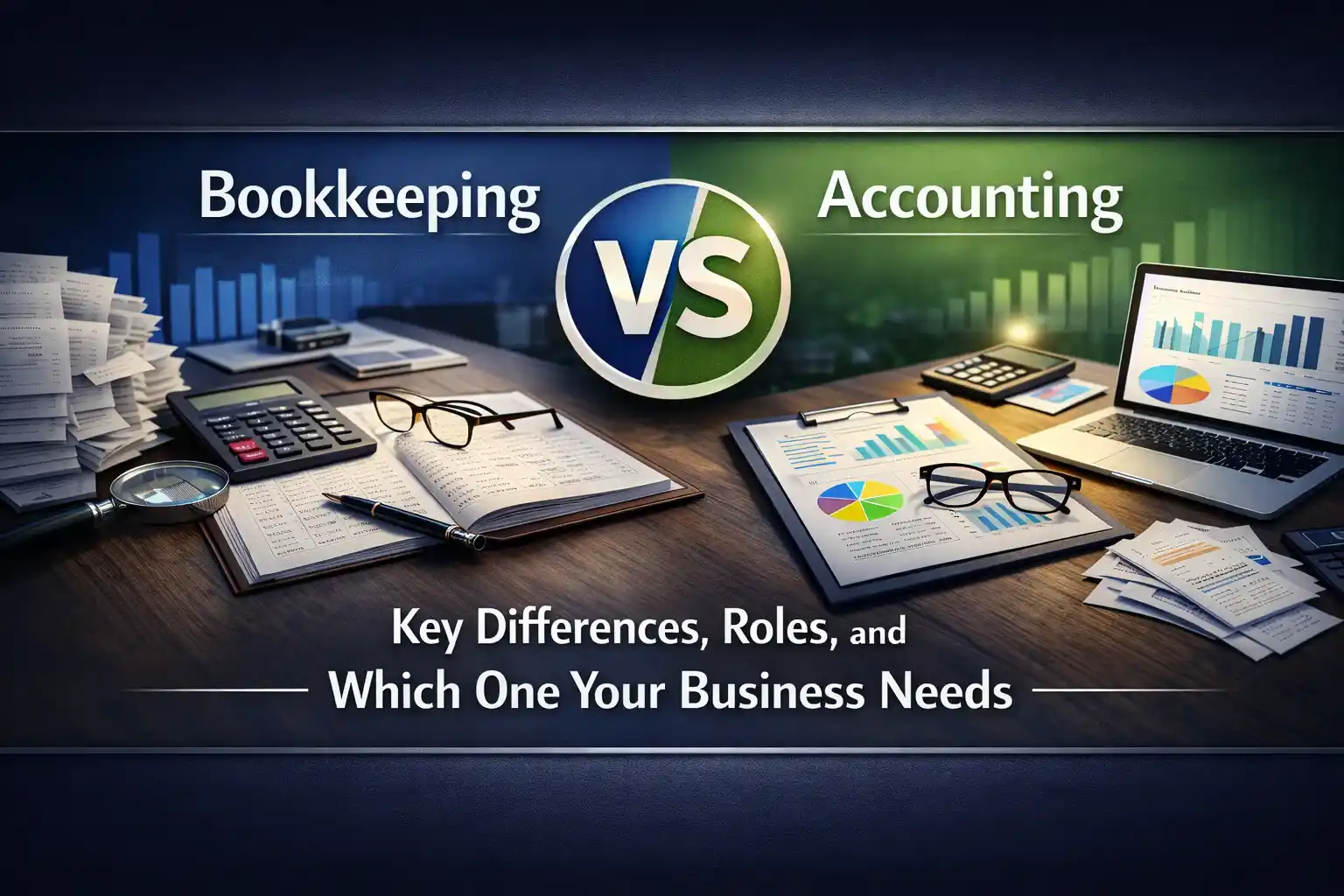
Bookkeeping vs Accounting: Key Differences, Roles, and Which One Your Business Needs
Having financial clarity is no longer a choice among businesses in the United States, but a requirement. SCORE states that approximately 40% of small enterprises cite some financial issues as their primary operational concern, and IRS statistics show that the accounting and reporting mistakes are the leading contributors to fines. Nonetheless, it does not dispel the confusion among many business owners about whether to leave their finances to be handled by bookkeeping or accounting. A lack of clarity about the distinction between bookkeeping and accounting often drives such confusion. Although both functions work with financial data, their goals, depth, and impact on decision-making differ significantly. Learning about bookkeeping and accounting is beneficial for avoiding financial risks, staying in compliance, and making vital strategic business decisions. Here is a detailed breakdown guide to ensure the proper financial support in your industry. Bookkeeping vs Accounting: An Overview The core of any financial system is bookkeeping and accounting, but they play different roles within it. Bookkeeping is primarily concerned with recording economic activity as it occurs and ensuring that all transactions are meticulously recorded in the same manner. Instead, accounting uses recorded data to evaluate performance and inform decision-making. Bookkeeping and accounting are not interchangeable, as so many business owners in the US would want to believe. As a matter of fact, bookkeeping gives us an answer to what has happened financially, whereas accounting provides us with an answer to why something has happened and what to do next. This difference will become even more significant as businesses expand, regulate, and operate in increasingly complex environments. Bookkeeping and accounting are not competing functions but depend on each other. Proper bookkeeping means adequate accounting, and appropriate accounting indicates where a person can improve their bookkeeping processes. This relationship helps businesses develop a sustainable financial system. What Is Bookkeeping? Bookkeeping is the process of recording daily financial transactions in an organized manner. It provides a good set of books of account, as all sales, expenses, payments, and receipts are traced, forming a credible financial record. This is crucial for transparency and audit preparation. The primary bookkeeping operations are to record income and expenses, maintain general ledgers, reconcile bank and credit card accounts, handle invoices, track accounts payable and receivable, and process payroll. With these activities, the financial data is corrected and kept current daily or weekly. Commonly used accounting software for bookkeepers includes QuickBooks, Xero, Wave, Zoho Books, and Excel. Their clinical should be very accurate, uniform, and conversant with accounting rules. Although bookkeepers do not interpret financial trends, their work directly influences the quality of financial reports and the risk of tax evasion. Read more: What are bookkeeping services What Is Accounting? Accounting is not only financial record keeping; it is also concerned with interpreting financial records to evaluate business performance. It converts unorganized bookkeeping entries into organized financial statements, i.e., income statements, balance sheets, and cash flow statements. Basic accounting services include financial analysis, budgeting, forecasting, tax planning, compliance with IRS regulations, and advisory services. It is also through the assistance of accountants that businesses can assess profitability, risk management, and business growth. This is what makes accounting an operational, not a strategic, function. Another tool accountants use is state-of-the-art software such as QuickBooks Advanced, NetSuite, Sage, financial modeling software, and tax platforms. The skills they have are analytical, regulatory, and strategic intelligence. In the context of US companies operating under tax regulations and accounting standards, accounting is a key factor in long-term sustainability. Bookkeeping vs Accounting: Side-by-Side Comparison Bookkeeping and accounting are closely related but differ significantly in terms of responsibility. This knowledge of the distinction between bookkeeping and accounting helps a business owner or proprietor make the correct business decision. Basis of Comparison Bookkeeping Accounting Primary purpose Records and organizes all financial transactions accurately and consistently Analyzes, interprets, and reports financial data to support decision-making Type of data handled Raw financial data (sales, expenses, payments) Processed and summarized financial data Timing of work Performed daily or weekly Performed monthly, quarterly, and annually Financial statements Prepares basic records that support statements Prepares, reviews, and interprets financial statements Tax involvement Records tax-related transactions Tax planning, filing, and IRS compliance Regulatory compliance Indirect involvement Direct responsibility (GAAP, IRS, state regulations) Business insights Does not provide strategic insight Provides recommendations for growth, cost control, and profitability Decision-making role Supports decisions indirectly Plays a direct role in financial and strategic decisions Tools used QuickBooks, Xero, Zoho Books, Wave, Excel NetSuite, Sage, QuickBooks Advanced, tax, and reporting software Ideal business stage Startups and small businesses with simple transactions Growing and established businesses with complex finances This distinction between bookkeeping and accounting underscores the need for both functions at various phases of business development. How Bookkeeping and Accounting Work Together? Bookkeeping and accounting are two interrelated processes within the financial process, which rely heavily on each other to be accurate and effective. Bookkeeping is the backbone of operations since it aims at recording all the financial transactions that a business makes, i.e., sales, expenses, payments, and receipts, in an organized and timely fashion. If this data collection is inconsistent, the financial information will be incomplete, unreliable, and difficult to analyse. After bookkeeping has prepared a form of the financial data, the accounting layer is based on this data and involves interpreting and assessing it. It is through bookkeeping records that accountants prepare financial statements, including income statements, balance sheets, and cash flow reports. These reports help business owners understand profitability, economic stability, and performance. This is what accounting does: converting raw numbers into valuable insights used for decision-making. The connection between bookkeeping and accounting may be explained as a workflow: Transactions → Bookkeeping → Financial Records → Accounting Analysis → Business Decisions. The success of each step depends on the precision of the other. Poor-quality or incomplete bookkeeping data will be reflected in the accounting report, leading to poor financial decision-making or compliance risks. This cooperation is particularly imperative to US businesses regarding tax compliance and financial
Read More
Blog
Dec 18, 2025
A Complete Guide on Accounts Payable Outsourcing
Accounts Payable (AP) is not only a back-office accounting activity, but it also directly influences cash flow visibility, vendor trust, compliance readiness, and overall financial control. But for most expanding businesses, AP is where anarchy silently accumulates. Invoices clog inboxes, approvals slow down, duplicated payments pass through, and finance departments waste more time correcting mistakes than crunching figures. Increased invoice volumes and more complex operations make in-house accounts payable inefficient, costly, and risky. That is precisely why companies across sectors are currently selecting accounts payable outsourcing not as a cost-reduction strategy but as a business initiative to enhance accuracy, speed, scalability, and financial control. This is the full outsourcing accounts payable guide to inform you about what outsourcing accounts payable is, how it functions, its benefits and constraints, cost-based structures, and how it relates to accounts payable automation- a complete demonstration of whether it is the correct choice to outsource AP to your business. What Is Accounts Payable Outsourcing? Outsourcing is the act of assigning all or part of the AP functions to a third-party service provider. Businesses outsource accounts payable to avoid the burden of processing invoices, obtaining approvals, communicating with vendors, and making payments within their organization, because expert teams handle these tasks at a relatively low cost and with the required professional expertise and technology. These accounts payable outsourcing services may be partial (supporting specific tasks) or end-to-end, depending on the business’s requirements. Why Businesses Outsource Accounts Payable The vast majority of companies do not outsource AP because they want to; they do so because the current process has ceased to work. Common triggers include: How Accounts Payable Outsourcing Works All steps are monitored through secure systems, which provide businesses with real-time visibility but not day-to-day operational intervention. What are the Advantages of Outsourcing Accounts payable? The Following are some key advantages of outsourcing accounts payable: Cost Savings Outsourcing will reduce the cost of recruiting, training, and maintaining an in-house accounts payable team. The business saves on software licenses, hardware, and office infrastructure. Most firms enjoy a 30–60% cost reduction with Accounts Payable outsourcing. Higher Accuracy AP mistakes, such as paying twice or incorrectly matching bills, may be very expensive. Outsourcing reduces these risks because the specialists use automated tools, OCR systems, and tight validation checks to get high accuracy for each transaction. Smart Processing Outsourcing invoice processing will accelerate with round-the-clock teams and automated workflows. Faster approvals and on-time payments build good relations with vendors and help avoid penalties or late fees. Improvement in Compliance AP outsourcing partners must comply with local tax laws, accounting guidelines, and audit requirements. They maintain comprehensive documentation and digital audit trails so your business will always remain compliant with financial regulations. Scalability Businesses also experience seasonal fluctuations in invoice volume. Such operations can be easily scaled up or down by service providers with no disruption, enabling seamless performance without additional internal staff. Technology Access AP outsourcing firms today deploy AI-driven OCR, 3-way matching tools, automated approval flows, and digital dashboards. In such cases, the firms can access the advanced system without purchasing it, thereby reducing the technology burden. Accounts Payable Outsourcing vs Accounts Payable Automation Category Account Payable Outsourcing Account Payable Automation Definition Under it, the third-party provider is hired so that they can handle accounts payable processes like invoice processing, validation, vendor communication, and payments Here, accounts payable software or technology to automate tasks like invoice capture, matching, approval workflows, and payments Who performs the work? External Account payable and service teams manage all tasks The internal finance/accounts payable team will manage the tasks with the help of software Technology Requirement The outsourcing partner provides the tools and system Business needs to purchase or subscribe to automation software Cost structure Usually paid per invoice, per month, or through custom accounts payable outsourcing packages Usually paid as a software subscription (SaaS), License fees, or per-user pricing Overall objective Reduce internal dependency and transfer accounts payable responsibilities to specialists Minimize the manual work by automating the repetitive accounts payable tasks internally Implementation Time Quick, as outsourcing companies use ready-made systems and trained teams Can be longer due to custom configurations, integrations, and workflow setup Security Responsibility Securityis  maintained by the outsourcing partner with strict protocols Businesses must ensure secure configurations, integrations, and workflow setup. Turnaround Speed Fast processing due to dedicated teams working around the clock Fast processing, but it depends on the team’s responsiveness to approvals and exceptions. How much does it cost to outsource Accounts Payable? Cost is one of the major factors in determining whether a business should outsource accounts payable. But how much does outsourcing accounts payable cost? Cost Determinants Volume, invoice complexity, workflow structure, levels of compliance, and the inclusion of automation tools are among the factors considered. Normally, companies with big volumes get lower per-invoice rates. Pricing Models Most outsourcing companies offer pricing options such as per-invoice charges, per-month subscription fees, or a full-service annual contract, to give a business flexibility in choosing the option that best suits its needs. Average Price Range Prices start with an average of Rs 20- Rs 150 per invoice in India or Rs 25,000 to Rs 2,00,000 per month for medium-sized companies. Large enterprises with complex workflows get custom packages. Cost Benefit While outsourcing is not free, it is reasonably a lot cheaper than trying to manage an in-house AP setup. Companies save up on salaries, software, infrastructure, and error-related penalties when outsourcing turns out to be the financially smart decision. What Processes can be outsourced in Accounts Payable? This can be partial or full outsourcing of many AP functions, depending on the requirements of the company. Invoice Receipt & Capture The invoices are collected by the outsourcing team through emails, portals, and scanning. Further, they use OCR and intelligent data capture for quick extraction of available information. Invoice Validation & Matching This involves invoice details verification, matching that includes 2-way against purchase orders and 3-way against goods receipts, and vendors’ verification. This helps weed out incorrect and
Read More

Frequently Asked Questions

Yes. We provide white-label and outsourced AR solutions to U.S CPA firms.
Absolutely. Our AR solutions are scaled and adapted to your business.
No. To preserve relationships, we adhere to professional, brand-congruent communication practices.
We deal with QuickBooks, Xero, Sage, and other cloud-based systems.
Pricing will be based on invoice volume, the number of customers, and the scope of service. Request a custom quote.

Get a Free Quote

Fill out the form and our team will reach out to you within 24 hours.