

 Australia
 UK
 Ireland
 Canada
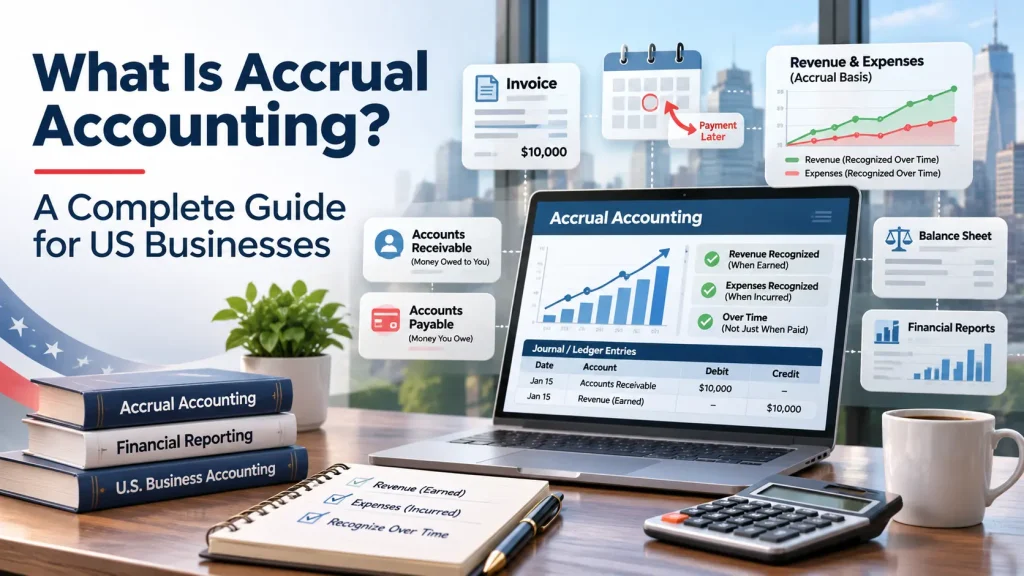




Expenses and revenue don’t necessarily always follow suit. Due to prepaid and pay-later facilities, a business may incur an expense and receive payment in different time periods. The multiple cash flows and different timelines may seem challenging to keep track of, but all transactions must be managed accurately.
Considering the different timelines of transactions, there are different methods of accounting that businesses use, and one of them is accrual accounting. It becomes relevant especially since you need to recognize expenses as they are incurred and revenues as they are earned, and not when the payment is actually received.
Read on as we explore accrual accounting, its different elements and types, and best practices for businesses.
What Is Accrual Accounting?
The accrual accounting method records expenses as they occur and revenue when it is earned. The method doesn’t consider the actual time frame when the business receives the payment. In doing so, this accounting method allows businesses to get a more accurate picture of their financial performance and not just how the cash is flowing.
What is accrual basis accounting based on? It works on the matching principle. You record the expenses and revenue of the same period and match the two to determine your profit or loss.
Accrued and Accrual: Understanding the Difference
They might sound similar, but there is a strict difference.
- Accrued: It is revenue that has been earned or an expense that the business has incurred but is yet to be recorded in the business’s financial statements. An example is a business consuming a resource in one month and getting the invoice the next month.
- Accrual: It is the process of recognizing the expense when it is incurred or revenue when it is earned. The time period of the actual payment can be different. An example can be a business recording revenue in March even though the payment is received in April.
Key Elements of Accrual Accounting
Four important concepts help businesses use accrual accounting effectively. Each addresses a different situation involving the timing of payments, revenue, and expenses.
Accrued Revenue
When a business has provided the goods or services and recognized the revenue for the same, but has not received the payment yet, it is referred to as accrued revenue. The business recognizes the accrued revenue in the same time period when it is earned, regardless of the payment status. On the balance sheet, it is shown as an asset (accounts receivable), and on the income statement, it is recorded as revenue.
Example: An agency completes a project worth $4,000 in September and receives the payment in November. It records the amount as accounts receivable on the balance sheet and revenue on the income statement in September.
Accrued Expenses
When a business has incurred the costs but has not cleared the payment by the end of that period, it is recognized as an accrued expense. Since they represent obligations the business must settle eventually, accrued expenses are recorded as liabilities.
Example: A manufacturing company uses $800 worth of electricity during their operations in November but pays the bill in December. The amount is recorded as an expense in November.
Prepaid Expenses
When a business makes a payment in advance for goods or services it will use in the future, it is termed a prepaid expense. Since the business has paid for something that will provide a future benefit, the amount is initially recorded as an asset on the balance sheet. It is then gradually recognized as an expense as the business receives or uses the related goods or services.
Example: A company pays $6,000 for a 6-month accounting software subscription. It records the amount as an asset (prepaid expense) initially but records $1,000 as expense every month for the next 6 months.
Deferred Revenue
When a business receives an advance payment for goods or services that are yet to be delivered, it is called deferred revenue. This revenue is recognized as a liability on the balance sheet because it is still an obligation the business has not met yet. Once the business starts delivering the goods or services, it is gradually recognized as revenue.
Example: A business receives a payment of $1,200 in June for a 3-month maintenance service contract. Initially, it records the entire amount as a liability, but it starts recording $400 every month for the next 3 months as revenue.
Accrual Accounting vs Cash Accounting
Timing of revenue and expense recognition are the two major points of difference between accrual accounting and cash accounting. In Cash accounting, tracking cash flow may seem easier since it focuses on actual cash transactions. On the contrary, the need to match time periods of financial activity when revenue is earned or expenses are incurred can be a little complicated, but it does provide a fuller picture of financial performance in a given time period.
Here’s how the two compare:
| Basis of comparison | Cash Basis Accounting | Accrual Basis Accounting |
|---|---|---|
| When transactions are recorded | Records revenue when cash is received and expenses when payments are made. | Records revenue when earned and expenses when incurred, regardless of payment timing. |
| Accounts receivable and payable | Does not account for unpaid customer invoices or outstanding bills as accounts receivable and payable for income determination. | Records unpaid customer invoices as accounts receivable and outstanding bills as accounts payable. |
| Financial performance | Shows actual cash received and paid but may not reflect outstanding income or expenses. | Provides a more complete picture of revenue earned and expenses incurred during a reporting period. |
| Complexity | Simpler to maintain, with fewer adjusting journal entries. | More complex and requires detailed records, accounting systems, and periodic adjustments. |
| Cash flow tracking | Makes it easier to track cash received and payments made. | May show revenue before payment is received, making separate cash flow monitoring important. |
| GAAP compliance | Does not comply with US GAAP. | Complies with US GAAP and is used for financial reporting under these standards. |
| Common users | Often used by small businesses and sole proprietors, subject to applicable tax rules. | Commonly used by businesses that need detailed financial reporting and performance measurement. |
The Advantages of Accrual Accounting
Businesses often prefer accrual accounting due to the following benefits:
- More Accurate Financial Insights: As this method records expenses and revenue for a specific time period instead of focusing on the actual cash flow, it can provide comprehensive information on profit and loss.
- Better Decision-Making: Businesses can make more informed decisions.
- Reporting Consistency: This method maintains consistency in reporting periods, which is important for tracking performance trends.
- Confidence from Financial Statement Users: Accrual-based reports are often the preferred choice for financial statement users because they offer a more realistic picture of the financials.
- More Favorable Credit Terms: Lenders may see businesses relying on accrual accounting as better professionally managed and offer more favorable terms.
- Regulatory compliance: Accrual accounting is the external reporting requirement for many accounting frameworks and regulatory bodies.
The Limitations of Accrual Accounting
Below are a few drawbacks that businesses should consider when using accrual accounting:
- Complexity: Businesses need robust accounting systems and relevant expertise for accrual accounting, as well as significant time from the accounting team.
- Separate Cash Flow Tracking: Even though accrual accounting provides important insights, businesses will still need to track their cash flow separately.
- Misstatement Risk: There is a risk of misstating expenses or revenue if accounting is not managed properly.
Industry-Specific Applications of Accrual Accounting
Industries where revenue recognition, outstanding payments, and expenses cover multiple accounting periods can find accrual accounting useful.
Construction
Businesses use percentage-of-completion accounting for eligible long-term projects to recognize revenue based on the progress of the work. This helps track project performance and margins over time.
Software as a Service (SaaS)
Companies offering annual or multi-year subscriptions recognize revenue over the service period rather than recording the entire payment upfront. Payments received in advance are initially recorded as deferred revenue.
Retail and Manufacturing
Businesses use accrual accounting to match the cost of goods sold with related sales. It also supports inventory valuation methods such as FIFO (First-In, First-Out) and LIFO (Last-In, First-Out)
Healthcare and Legal Services
Healthcare providers and legal firms recognize revenue when services are performed, even if payment or insurance reimbursement comes later. This also helps them track outstanding receivables and payables.
Best Practices for Accrual Accounting
A disciplined monthly routine is key to efficient accrual accounting. Businesses need to recognize and record revenue and accruals consistently and reconcile the accounts that carry balances between periods.
Here are the best practices to follow when using accrual accounting:
- When to Record Revenue: Record revenue when goods and services are delivered; even for long-term or subscription-based services, recognize revenue as the service is being delivered.
- How to Record Accruals: Record accruals regularly, and they should include salaries, utilities, and interest in the period they are incurred, regardless of their payment status.
- How to Reconcile Accounts: Check accounts receivable, accounts payable, prepaid expenses, and deferred revenue for any errors. You may also opt for outsourced accounting services for efficient account reconciliation.
- How to Monitor Cash Flow: Keep track of cash balances, overdue customer payments, and upcoming expenses along with reported profits to spot potential shortages.
How Do You Choose the Right Accounting Method for Your Business
The right accounting method depends on your business operations, financial reporting needs, and tax obligations. Consider these factors:
- Revenue Recognition: If your business completes projects, provides ongoing services, or sells annual subscriptions, consider how revenue needs to be recognized across different accounting periods.
- Outstanding Payments: If customers frequently purchase on credit or you regularly have unpaid supplier bills, consider a method that accounts for receivables and payables.
- Inventory and Operating Costs: If you sell or manufacture products, your accounting method should help track inventory costs and match the cost of goods sold with related sales.
- Financial Reporting: If your business needs to prepare financial statements under US GAAP or share financial information with investors and lenders, accrual accounting is generally more appropriate.
Spend Less Time on Accounting. More Time Growing Your Business.
Get reliable outsourced accounting support for bookkeeping, reconciliations, financial reporting, and more with Aone Outsourcing.
When Accrual Accounting Becomes the Requirement: Legal Compliance
When maintaining accurate inventory, as businesses can record inventory costs and match the cost of goods with the sales revenue, accrual accounting can be useful. More importantly, it can become a legal requirement in certain scenarios.
As established by Bulletin No. 2025-45 published by the IRS on November 3, 2025, when C-corporations’ average annual gross receipts exceed $32 million, they cannot use the cash accounting method, and accrual accounting becomes a requirement for tax purposes under IRC §448(c).
Farming businesses and qualified personal service corporations enjoy exceptions under §448(b).
Why Businesses Choose Aone Outsourcing
Managing day-to-day accounting can take time away from running a business or serving clients. Aone Outsourcing helps US businesses and CPA firms handle recurring accounting tasks with flexible offshore support. Our accounting professionals work within your existing software, workflows and reporting procedures, so you can add capacity without building every function in-house.
Here’s how Aone Outsourcing can help your business:
- Accounting Support Dedicated to Your Business: At Aone Outsourcing, you receive accounting professionals dedicated to ongoing workloads for bookkeeping, reconciliations, AP, AR, month-end close, reporting, and other accounting functions.
- Capacity to Grow with Your Needs: Our team is equipped to expand the scope of support as your transaction volumes, clientele and workloads increase.
- Consistent Review and Quality Checks: We have proper accounting procedures and review checkpoints. Our team checks entries and supporting documents to identify discrepancies, pending items and missing information.
- Broad Accounting Software Support: We can work with a wide range of accounting software, including QuickBooks Online, Xero, NetSuite, Sage Intacct, Oracle Fusion Cloud financials, Zoho Books, Microsoft Dynamics 365, and Medius.
- Support Across Multiple Industries: We offer our accounting services, bookkeeping services and other offerings to businesses across consumer, retail, financial, professional services, hospitality, travel, event, real estate, construction, logistics, transport, trade, and franchise.
- Controls Remain with You: You continue to have complete control over your business relations, professional judgment, financial decisions, and final approval. We handle the agreed-upon tasks.
Wrapping Up
Accrual accounting allows businesses to match the expenses and revenues of the same time period and do a better assessment of their financials. This method may require additional expertise and time, but it can provide a more detailed view when other methods stick to cash flow tracking.
Find skilled and industry-experienced accountants for your accounting, bookkeeping, and financial reporting needs with Aone Outsourcing. Get a dedicated team to manage your growing workload and make financial decisions with confidence.
Frequently Asked Questions
What is accrual accounting in simple terms?
Accrual accounting allows a business to record its expenses as they are incurred and revenue as it is earned instead of waiting for the actual transactions. This helps assess expenses and revenue for a certain time period, which makes profit and loss evaluation easier.
Can small businesses use accrual accounting?
If the business heavily relies on prepaid or late payment transactions and needs to record expenses and revenue as they occur, accrual accounting can be helpful. Ultimately, it depends on the business requirement.
Do I need accrual accounting for my business?
The requirement for accrual accounting depends on the type of business you have. For instance, if you need to maintain inventory or offer subscription-based or other long-term services with bundled payments, you can benefit from accrual accounting.
How does accrual accounting impact cash flow?
By recording expenses and revenue as they occur, accrual accounting can record a profit or loss even before the cash is exchanged. Businesses must track their accounts receivable, upcoming payments, and cash balances along with their reported profit or loss to manage cash flow effectively.
What financial statements can I create using accrual accounting?
You can make income statements, balance sheets, and cash flow statements using accrual accounting.