


Limited-Time Offer: 30% Off Standard Fees Until August 2026 — Hire Expert Accountants from India & Build Your Global Team.
Book a Meeting
menu
5,000+
Happy Clients

Outsourced Tax Return Services for CPA Firms

Accurate, IRS-compliant tax return filing that scales with your workload, without seasonal hiring, compliance pressure, or internal burnout. Aone Outsourcing Solutions offers stable outsourced tax returns preparation services to CPA firms in the United States. We make sure all returns are made accurately, in accordance with current tax laws, and on time, so you can meet peak workloads without disrupting quality or timelines.

  • ✨ 50,000+ Tax returns prepared every year.
  • ✨ 100% Federal & State compliance coverage

We are your one-stop shop for organized, ready-to-file tax return services, guaranteeing proper filings, fewer errors, and total peace of mind when tax time comes.

What’s Included?

  • Individual & business tax return preparation
  • Federal & multi-state tax filings
  • Tax extensions & deadline management
  • Review-ready working papers & documentation
  • IRS notices & amended return support
Get Started Now

Tax Return Services for CPA Firms

At Aone Outsourcing Solutions, we support CPA firms across the United States with dependable outsourced tax return services that help you handle peak-season volumes without sacrificing accuracy or review control. We understand how quickly tax workloads escalate, including individual returns, business filings, extensions, and federal and state compliance, while your firm is still expected to deliver advisory value and client confidence.

When tax preparation overwhelms internal teams, the consequences are immediate: delayed filings, review bottlenecks, increased risk of errors, and staff burnout during critical deadlines.

That’s where we step in. Through our structured tax preparation workflows and secure, cloud-based systems, we operate as a seamless extension of your firm. Supported by experienced tax professionals, CPA-ready documentation, and multi-level quality checks, we deliver accurate, reviewer-ready tax returns, so your team can focus on client relationships, advisory services, and firm growth.

The Benefits of Outsourced Tax Return Services

icon

Experience in the U.S. Tax Regulations

The taxation policies in the United States are very complicated, in a state of continuous change, and are regularly updated at the federal and state levels. Our seasoned tax preparers are informed of the new IRS regulations, deductions, credits, and compliance mandates.

icon

Reduced Workload During Peak Season

The tax season may strain internal teams, leading to excessive hours, burnout, and inefficiencies. Outsourcing will help you share the burden of preparing tax returns and avoid overburdening employees. This will enable your team to be productive and concentrate on high-value services such as advisory and client communication.

icon

Faster Turnaround Times

It is important to meet filing deadlines to ensure we keep our clients and avoid penalties. We have streamlined our processes, committed teams, and effective procedures to ensure tax returns are prepared and delivered quickly, even during peak periods. This can help you meet deadlines without cutting corners.

icon

Better Accuracy and Reduction of errors

The consequences of mistakes on tax returns can be severe, including fines, an audit, and loss of reputation. Our multi-level quality control mechanism will ensure that every return is carefully checked for accuracy, completeness, and compliance. This greatly minimizes the risk of mistakes and ensures a high-quality output each time.

icon

Scalability & Flexibility

It also depends on the volume of returns you have to support, as well as large volumes during peak season, and our services have the capacity to scale depending on your requirements. Capacity can be added or removed easily without the burden of recruiting, training, and managing new employees. It is a very versatile solution for CPA firms and other businesses.

icon

Significant Cost Savings

Seasonal employees, training, and maintenance of other facilities can be costly. The cost of these is reduced through outsourcing, and experienced professionals are made available. This will enable you to maximize your budget and invest more in growth-oriented activities.

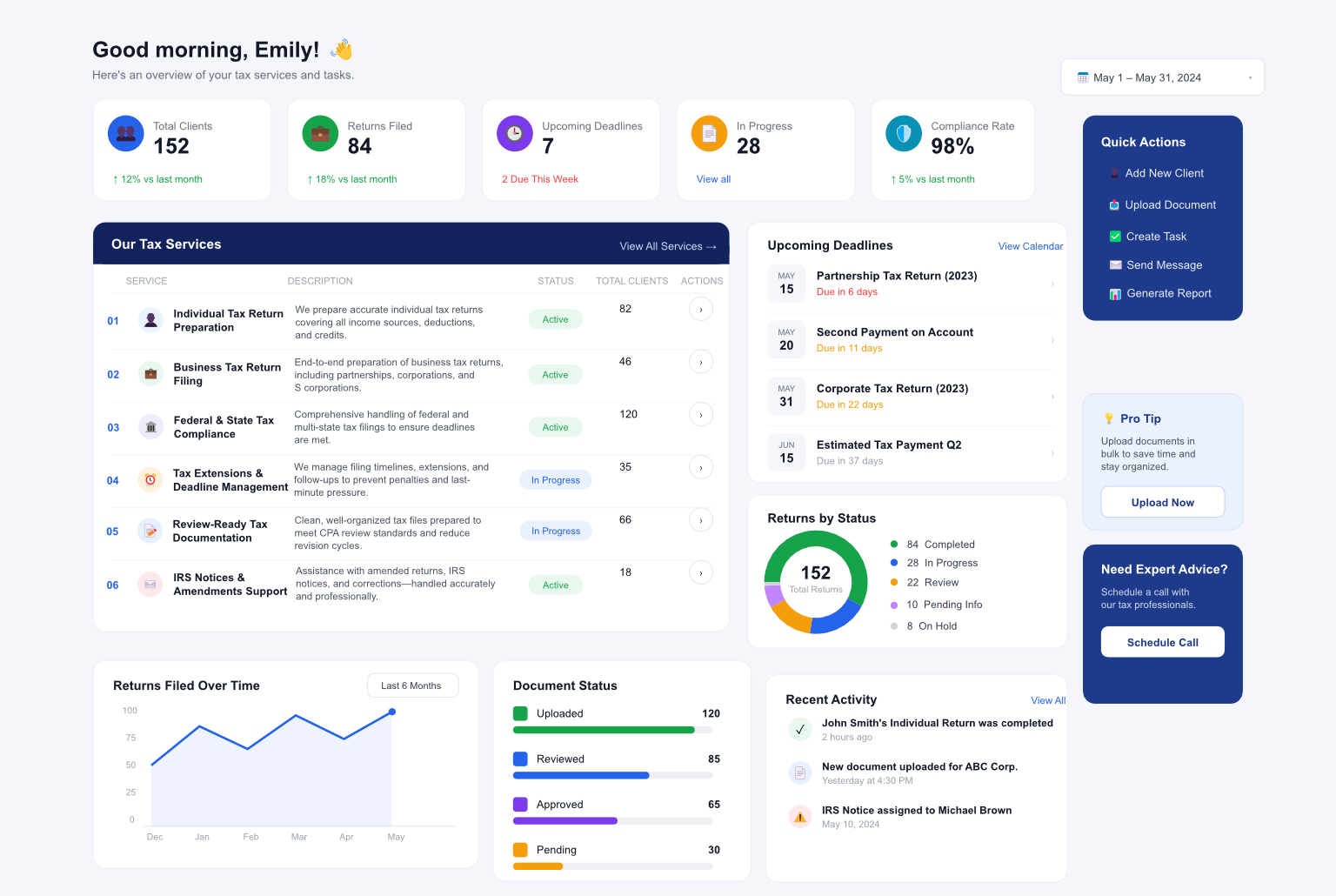
Our Services: What We Provide

01

Individual Tax Return Preparation

We prepare accurate individual tax returns covering all income sources, deductions, and credits, ensuring compliance with current IRS regulations and review-ready documentation.

02

Business Tax Return Filing

End-to-end preparation of business tax returns, including partnerships, corporations, and S corporations, aligned with financial records and federal and state requirements.

03

Federal & State Tax Compliance

Comprehensive handling of federal and multi-state tax filings to ensure deadlines are met and compliance risks are minimized.

04

Tax Extensions & Deadline Management

We manage filing timelines, extensions, and follow-ups to prevent penalties and last-minute pressure.

05

Review-Ready Tax Documentation

Clean, well-organized tax files prepared to meet CPA review standards, reducing back-and-forth and revision cycles.

06

IRS Notices & Amendments Support

Assistance with amended returns, IRS notices, and corrections—handled accurately and professionally.
How Our Process Works

01

Onboarding & Requirement Alignment

We understand your filing requirements, client profiles, forms involved, deadlines, and review expectations from day one.

02

Secure Access & Document Setup

Encrypted access is established for document sharing and system integration, ensuring full confidentiality and compliance.

03

Dedicated Tax Professionals

Your returns are handled by dedicated tax preparers, supported by internal quality reviewers for consistency and accuracy.

04

Tax Preparation & Compilation

We prepare returns in line with IRS and state regulations, aligned with bookkeeping and financial records.

05

Review & Quality Checks

Each return undergoes multiple quality checks to ensure accuracy, completeness, and compliance.

06

Filing & Ongoing Support

Approved returns are e-filed on time, with continued support for extensions, notices, and amendments.

Trusted by Businesses That Value
Accuracy & Timely Filing

Let our Tax Return experts handle preparation, compliance, and deadlines, so you can focus on growth without the pressure.

No obligation

One Month Free Trial

Free 15-minute discovery call

Tailored tax strategy

Why Choose Aone Outsourcing Solutions

icon

Flexible Engagement Models

Scale tax preparation capacity up or down during peak seasons without hiring or training temporary staff.

icon

CPA-Friendly Workflows

Processes designed to integrate smoothly into CPA review cycles and internal systems.

icon

Fast Turnaround Times

On-time delivery, even during high-volume tax seasons, without compromising accuracy.

icon

Experienced Tax Professionals

A team of trained tax preparers and reviewers delivering consistent, high-quality output.

icon

Secure & Confidential Processing

Strict data security, NDAs, and confidentiality controls at every stage.

icon

24/7 Support

Responsive support across time zones when deadlines don’t wait.

The Smarter Way to Manage Tax Returns in the USA

Feature Comparison Aone Outsourcing Solutions In-House Team Local CPA Firms DIY Software
Tax Return Preparation Always On Time Overloaded during peak Delayed Manual
Compliance & Accuracy 100% IRS compliant Depend on a person Moderate Risk-prone
Turnaround Time Fast & consistent Slower in peak season Variable Self-paced
Review Readiness CPA-ready Requires rework Basic Not structured
Monthly Investment Custom & flexible $6,000+ $3,000+ $100+
Scalability Seamless Slow hiring cycle Limited Can’t Scale

Industries We Serve

Professional Industry

Transport Industry

Logistics Industry

Travel & Event Industry

Consumer Industry

Financial Industry

Retail Industry

Construction & Real Estate Industry

Hospitality Industry

Trade Industry

Testimonials

What Our Clients Say

Tools & Technology We Use

software-logo
software-logo
software-logo
software-logo
software-logo
software-logo
software-logo
software-logo
software-logo
software-logo
software-logo
software-logo
software-logo
software-logo
software-logo
software-logo
software-logo
software-logo
software-logo
software-logo
  • Custom onboarding according to your tax workflows
  • Connections with tax software and systems
  • Checked data migration
  • Experienced tax auditors and examiners
  • No interruption in timelines to file
  • Response during peak tax seasons that can be scaled

Switching to Aone Outsourcing Solutions

Switching your tax return preparation to Aone Outsourcing Solutions is smooth, secure, and designed to avoid any disruption during critical filing periods. Whether you're transitioning from an internal team or another outsourcing partner, we ensure continuity, accuracy, and timely delivery. Your experts fit your current workflows, analyze your past-year returns, and safely migrate all relevant information before commencing. With a structured onboarding and multi-tier validation, we are consistent across filings without affecting your deadlines or review cycles.

Switch Now ↗

Insights & Updates

Blog
Aug 17, 2026
Small Business Bookkeeping: A Complete Guide for Beginners in 2026
Small business bookkeeping is the ongoing process of recording every dollar that moves through your company — sales, expenses, payroll, and everything in between. It matters because clean records are what make tax filing, financing, and day-to-day decisions possible. This guide walks through every method available for small business bookkeeping in 2026: spreadsheets, software like QuickBooks and Xero, freelance bookkeepers, and full outsourcing — with real 2026 pricing, current IRS requirements, and the signals that tell you it’s time to hand the work off to a service like Aone Outsourcing Solutions. What Is Bookkeeping? Bookkeeping involves systematically recording every single financial transaction that occurs in your business all the money that comes in and goes out of your business. Whether it is sales, expenses, payroll, returns and reimbursements or even payments on your loans everything is recorded and sorted out to create a financial record. It’s worth drawing a clear line between bookkeeping and accounting, because small business owners often use the terms interchangeably and they shouldn’t. Bookkeeping is the foundation: the daily and weekly act of capturing raw financial data. Accounting builds on that foundation — it’s the analysis, interpretation, and strategic use of that data to file taxes, create a growth plan, and make financial decisions. If your books are messy, your accountant’s job becomes harder and more expensive. If your books are clean, everything downstream — tax filing, financial planning, loan applications runs smoother. Why Do Small Businesses Need Bookkeeping? Here’s what most beginner guides won’t tell you directly: Poor bookkeeping is one of the leading reasons small businesses fail. Not because of bad products or weak marketing — but because owners lose visibility into their own finances until it’s too late. Clean, consistent bookkeeping does several things for your business simultaneously. Handing over clean books signals that you run a serious operation. And perhaps most practically for the day-to-day, it eliminates the annual tax season panic that so many small business owners know all too well. Bookkeeping Options for Small Business Owners There’s no single right answer here — the best approach depends on your business size, complexity, and how much time you can realistically dedicate to financial management. DIY with Spreadsheets works for very early-stage businesses a freelancer, a sole proprietor with a handful of monthly transactions. It costs nothing, but it scales poorly and leaves plenty of room for human error. (If this is where you are, our guide to single-entry bookkeeping walks through the simplest version of this method.) DIY with Bookkeeping Software is where most small businesses should start. Software such as QuickBooks, Xero and Wave helps to do most of the recording automatically, connects directly to your bank accounts and provides financial reports with minimal effort. This software is easy to learn and affordable. Hiring a Freelance Bookkeeper makes sense once your transactions grow in volume or complexity multiple revenue streams, contractors to pay, inventory to track. A part-time professional can handle your books on a weekly or monthly basis without the overhead of a full-time hire. Outsourcing to a Bookkeeping Service like Aone Outsourcing Solutions is the most scalable option for US small businesses. You get dedicated professional expertise, consistent accuracy, and full financial visibility at a cost that’s typically well below what a part-time in-house employee would run you. It’s also the option that frees up the most of your time and for owners specifically searching for small business bookkeeping services rather than software, it’s usually the right next step once DIY stops scaling. (See our full breakdown of what outsourced bookkeeping actually involves.) Software Comparison: QuickBooks vs Xero vs Wave Choosing the right software is one of the most consequential early decisions you’ll make. Each of these three tools dominates a different segment of the market for good reason. Feature QuickBooks Online Xero Wave Starting Price $35/month $15/month Free Best For Most US small businesses Scaling businesses, international Freelancers, solopreneurs Payroll Add-on Yes (built-in) Yes (add-on) Yes (paid) US Tax Integration Strong Good Basic Ease of Use Moderate Easy Very Easy Bank Reconciliation Yes Yes Yes IRS-Ready Reports Yes Yes Limited Mobile App Yes Yes Yes Accountant Access Yes Yes Yes Pricing verified against current 2026 rates. Both QuickBooks and Xero raised prices earlier this year, so budget for the current rate rather than older figures you may have seen quoted elsewhere. QuickBooks Online remains the gold standard for US small businesses. It integrates seamlessly with most US tax software, is most familiar to accountants, and offers the most robust reporting. However, on the downside, this system is neither inexpensive nor user-friendly, and its pricing has increased significantly in 2026. Xero should be the preferred software if your company is growing fast and you have international customers. It’s also become increasingly popular with bookkeeping professionals, which matters if you eventually outsource. Wave is legitimately excellent for what it is — a free tool for freelancers and very small businesses on the Starter plan. The drawback of this tool becomes evident when you want more sophisticated reports, better payroll functionality, or stronger tax integration capabilities – when the Pro edition ($19/month) starts to make sense. How to Do Bookkeeping for a Small Business: Step-by-Step Getting your bookkeeping right from the start saves you from expensive fixes later. These six steps form the foundation every small business needs. Step 1: Create a Bank Account for Your Business Before you record a single transaction, keep your finances separate. Every dollar is traceable and clean thanks to a specific business credit card and checking account. One of the most frequent IRS red flags is the mixing of personal and business funds, which is completely preventable. In addition to saving hours of untangling later, this step is free.  Step 2: Choose Your Accounting Method Either method – cash or accrual. Cash method records revenues when received and expenses when paid – simple and appropriate for most small businesses. The accrual method records revenues and expenses at the time they are earned or
Read More
Blog
Aug 13, 2026
Best Accounting Firms for Small Business in the United States (2026)
The best accounting firms for small businesses in 2026 include Aone Outsourcing Solutions, Bookkeeper360, inDinero, Pilot, and Xendoo, with various combinations of U.S. tax compliance, cloud-based bookkeeping, and pricing that rises with the size of your business. There are a variety of top-10 options listed below, along with a few considerations and a comparison of the best ones. Running a small business in the United States involves many small operations, like juggling sales, business operations, and customer service; managing accounting is often the first thing to take a back seat. However, a stressful tax season and frequently costly errors occur with inaccurate books. That’s why it’s important to choose the right accounting firm as much as it’s crucial to choose the right software. We outline the necessary steps for small business owners to consider when assessing the best accounting firms in the United States: industry knowledge, technology, pricing transparency and scalability, and then present a comprehensive comparison table, our top 10 accounting firms list, and answers to the most frequently asked questions that business owners have before hiring an accounting firm. How to Select the Best Accounting Firm for Your Small Business. Not every accounting firm is created equal; the optimal option depends on your size, industry, and objectives. Before you make your decision about the best accounting firms for small business, we will review the key points to consider. Industry Expertise  There are accounting regulations that vary by sector. An accounting requirement for a restaurant differs from that of a tech startup or a construction company. These are some of the finer points that are known to the best accounting companies in the small business category. The best accountants for small business are aware of what costs they can charge off, which report will receive the most attention, and the regulatory measures applicable to the industry in which they are involved. An example is that an online retailer may require the services of a company handling property management accounts, and a real estate business may need the assistance of someone dealing with sales tax in several states. Technology and Tools Contemporary accounting has become digital. Leading accounting companies often resort to cloud-based accounting software, such as QuickBooks, Xero, or Zoho Books. These tools enable real-time working, accessible data, and quick reporting. Supposing your accountant continues to operate via email attachments and spreadsheets, it may be time to upgrade to a solution that incorporates automation, artificial intelligence, and secure portals to execute its functions more efficiently. Transparent Pricing They should be easy and foreseeable to price. The most appropriate minor accounting companies provide a flat fee every month or precise packages. Shun companies that impose non-existent charges on each minor query or feature that you did not subscribe to. An easily understood pricing model will enable you to create better plans, and you will not experience any surprises during tax season. Personalized Support Small companies usually prefer a personal touch. Large teams characterize big firms, whereas smaller accounting firms are more inclined to give more committed attention. You will also have a steady point of contact that is aware of your business’s past and future objectives. When you prefer a working relationship, you will want to select a company that values open communication and offers regular financial updates. Scalability and Flexibility  Today, your business might be a huge difference from what it will be in two years. Select an accounting company that can grow with you – from basic bookkeeping now to CFO-level financial planning tomorrow. It is this flexibility that will help you avoid swapping providers with each company’s growth. Quick Comparison: Top Accounting Firms for Small Businesses Firm Best For Starting Price Key Feature Aone Outsourcing Solutions Outsourced accounting at scale Custom quote Dedicated accountant, U.S. time-zone alignment Bench Accounting Online bookkeeping (post-restart) ~$199/month Monthly reports — see reliability caveat below QuickBooks Live Businesses already on QuickBooks ~$200/month Native integration with QBO Bookkeeper360 Performance dashboards + advisory ~$399/month Real-time metrics, fractional CFO add-on inDinero Funded, fast-growing startups ~$750/month Bookkeeping, tax, and CFO under one team Pilot Tech-forward startups ~$99/month (software-led entry tier) AI-assisted categorization, scales to accrual + CFO Xendoo Flat-rate cloud bookkeeping Custom quote Bundled bookkeeping, tax filing, and reporting Merritt Bookkeeping Ultra-simple, low-cost bookkeeping $190/month flat [verify] No transaction limits, one flat fee Mazuma USA Solo entrepreneurs and small LLCs Custom quote Bookkeeping + tax filing in one plan Acuity Accounting Full-service outsourced accounting Custom quote Scalable plans with dedicated CPA support Prices are approximate starting points as of 2026 and vary by transaction volume, entity type, and add-ons. Always confirm current pricing directly with the provider. The 10 Best Firms that offer CPA Services to Small Businesses. The following is a carefully curated list of the best small accounting firms that a small business can find in the U.S. These companies are selected based on the quality of their services, cost, technology usage, and client confidence. 1. Aone Outsourcing Solutions Best: Outsourced accounting at scale, without the overhead of an in-house hire. Starting Price: Custom quote based on transaction volume and scope. Why It Stands Out: Aone Outsourcing pairs each client with a dedicated accountant not a rotating support queue who works U.S. business hours and stays consistent month to month. That combination of offshore-outsourcing pricing with in-house-style consistency is the core differentiator versus larger, less personal platforms. Best Suited For: CPA firms, startups, and small businesses that want to scale their accounting function without adding headcount. 2. Bench Accounting Best For: Online bookkeeping and monthly financial reports with an important caveat. Starting Price: Approximately $199/month for the Essential plan as of 2026. Why It Stands Out and Why to Proceed Carefully: Bench was once one of the most recognized names in small business bookkeeping. On December 27, 2024, the company shut down abruptly, leaving customers without access to their books during year-end. It filed for bankruptcy in Canada in January 2025 with more than $65 million in disclosed debts, and its assets were
Read More
Blog
Aug 13, 2026
Best Accounting Firms for Venture-Backed Companies (2026 Guide)
The best accounting firms for venture-backed companies use technical accounting expertise with scalable finance operations. They help startups like venture-backed companies create a financial foundation to scale smoothly in the future. From investor reporting to cash-flow forecasting to fundraising preparation, the right accounting partner gives venture-backed companies a clearer path to financial visibility for making better growth decisions.  Poor cash flow management, inadequate budgeting, and resource misallocation are one of the main reasons for business failures for startups. The Business Research Company’s Accounting Services Market Report 2026 found 82% of failed small businesses went under due to poor cash flow management skills or a poor understanding of cash flow. This is why venture-backed companies need more than basic bookkeeping; due to the expectation of fueling rapid growth, strong financial management becomes even more critical. As funding increases & startups expand, their accounting needs become more complex and accrual accounting, investor reporting, financial forecasting, equity accounting, tax compliance, and audit or due-diligence readiness become significant factors in smoother financial operations. The right accounting firms for venture-backed startups can provide the expertise and scalable finance operations needed to manage this complexity while supporting long-term growth.  In this guide, we compare the best accounting firms for venture-backed companies in 2026 and explain what factors you have to evaluate before choosing an accounting firm as a venture-backed company. Why Venture-Backed Startups Need Specialized Accounting Firms According to the CB Insights report “The top 9 reasons startups fail”, 70% of startups fail because they ran out of capital. This is why venture-backed startups need specialized accounting firms to navigate complex, high-growth financial landscapes that traditional accounting services for venture-funded startups are not equipped to handle. Such type of accounting firms provide investor-ready reporting, manage complex equity structures and optimize R&D tax credits, which are critical for preserving cash runway.  Here is why specialized accounting is essential for venture-backed startups: Investor-Ready Reporting and Due Diligence For VC startups, accurate reporting done at a high level on a regular basis is essential, including key metrics such as burn rate, runway, customer acquisition cost, etc. Therefore, it is important to have specialized accounting firms for funded startups so that they comply with GAAP (Generally Accepted Accounting Principles) right from the beginning, ensuring there is no financial cleanup necessary at the time of due diligence when looking for funding again. Management of Complex Financial Instruments Many startups utilize advanced funding methods that include, but are not limited to, SAFE (simple agreement for future equity), convertible notes, and priced rounds. Such instruments can only be dealt with by qualified accountants, who are knowledgeable enough to correctly account for them by ensuring that equity compensation and cap tables remain precise.  Optimization of Cash Runway and Taxes Specialized VC-backed startup accounting firms assist VC startups in surviving and flourishing through the use of R&D tax credits (IRC §41), which can reduce payroll taxes for loss-making companies. They monitor burn rates and provide guidance that goes beyond just compliance issues. Technical SaaS and Revenue Recognition Numerous startups function using subscription approaches based on specialized revenue recognition (ASC 606) procedures when dealing with deferred income, multi-entity or multi-state entities.  Specialized Knowledge over Generic Service Startup-focused firms differ from traditional accounting firms because they try to understand the quick growth concept of startups and also offer state-of-the-art technologies, including QuickBooks Online, Brex, and Gusto, as part of their services. Transition from Cash to Accrual Accounting Usual accounting firms often rely on cash-basis accounting because it is simple, recording transactions only when money changes hands. However, venture capital companies require accrual-basis accounting mapped to GAAP standards. This prevents massive balance sheet distortions, allowing founders and investors to see the company’s true financial run-rate. KPI Tracking  Traditional accounting looks strictly at historical profit, loss, and tax liabilities. Venture-backed startups live and die by operational and unit economic metrics that traditional bookkeepers cannot track. Specialized firms provide deep, continuous tracking of your monthly burn rate and exact cash runway, telling you precisely how many months of survival you have left.  Audit Readiness Expectations As a startup matures, institutional investors often mandate an independent, full-scale financial audit. Trying to retroactively fix years of unvetted books for an audit is an incredibly expensive nightmare. Specialized accounting firms for venture-backed companies write explicit accounting policy memos on complex items like stock-based compensation expenses long before an auditor asks for them. This keeps your records inherently “audit-ready,” saving the company tens of thousands of dollars in emergency CPA cleanup fees down the line. Not sure if your books are investor-ready? Get a free financial health check from Aone Outsourcing’s startup accounting team we’ll flag the gaps before your investors do. Book a Free Consultation → How We Evaluate an Accounting Firm for VC-Backed Startups  We evaluate an accounting firm for VC-backed startups based on proven experience with VC-backed companies, specialized R&D tax credit knowledge, fluency in complex equity or cap table management, modern cloud-based tool stacks, and the capacity to provide audit-ready financial reporting. Startup & VC Expertise  We look for firms that are accustomed to working with startups and get venture funding decisions right, including knowing the intricacies of SAFEs, convertible notes, and equity rounds. R&D Tax Credit Capabilities  We only choose venture capital accounting services with specialized knowledge in evaluating and documenting R&D tax credits, which is crucial for saving on taxes in early stages. Audit-Ready Financials & GAAP Compliance  We only consider those accounting firms that are capable of moving from cash-basis to accrual accounting and preparing (Generally Accepted Accounting Principles) GAAP-compliant financial statements for investor due diligence.  Investor Reporting & SaaS Metrics  Our consideration list of firms for accounting for VC-backed startups should include firms that can produce monthly reporting packages that include burn rate, cash runway, and SaaS-specific metrics (ARR, MRR, Churn).  Technology Stack & Scalability  This is the most strictly followed eligibility criterion that we consider when choosing accounting firms for venture-backed companies. We only pick firms that use modern accounting tools like QuickBooks Online,
Read More
Blog
Aug 12, 2026
Financial Year in America: U.S. Fiscal & Tax Year Guide 2026–2027
One of the most significant deadlines for taxpayers, businesses, corporations, and governmental agencies in America is the end of the financial year. However, in contrast to most other nations where a standard system is used, in America, the financial year is a combination of varying fiscal years-federal, state, and business- which have their own regulations and reporting standards. It is a complex structure, particularly for small businesses, global companies, or anyone attempting to understand tax deadlines in the United States. The financial year is not just an ordinary 12-month period in the U.S., but one that defines how tax returns, budgets, and financial statements are prepared. Whether you are a business calculating your cash flow cycle, a corporation working out how long your financial year is, or an individual preparing your returns, it is important to understand which financial year America uses to stay current and plan. What Financial Year Is It Right Now? The United States is in federal Fiscal Year 2026 (October 1, 2025 – September 30, 2026). Individual taxpayers use calendar year 2026 (January 1 – December 31, 2026) for their tax years. As the previous state fiscal year (SFY) closed on June 30, 2026, most U.S. states have entered their 2027 SFY on July 1, 2026 and are heading into the June 30, 2027 deadline. Current Financial Year Snapshot Fiscal Year Type Start Date  End Date  Status  Federal Fiscal Year 2026 October 1, 2025 September 30, 2026 Current: closing soon Federal Fiscal Year 2027 October 1, 2026 September 30, 2027 Upcoming Most State Fiscal Years 2027 July 1, 2026 June 30, 2027 Current Individual Tax Year 2026 January 1, 2026 December 31, 2026 Current Source: U.S. Office of Management and Budget — Federal Budget ProcessSource: National Association of State Budget Officers (NASBO) — State Fiscal Year Data Financial Year vs. Calendar Year in the USA The first difference to appreciate in the US fiscal year is the distinction between a calendar year and a financial (fiscal) year. A calendar year is defined as the period between January 1 and December 31, and the financial year can be any other 12-month period elected for accounting. The relevance of this difference is substantial. A financial year ending after the busiest season is a popular choice with businesses with a seasonal cycle, including retail, agriculture, or tourism. Meanwhile, many taxpayers and small businesses focus on the calendar year because it coincides with the IRS tax year. For example: Knowing which structure you are under allows you to set your filing date, budget seasons, and compliance date. U.S. Federal Government Fiscal Year The federal government runs on a fixed cycle: October 1 to September 30 of the following year. This cycle governs: Federal Fiscal Year 2026 is October 1, 2025 through September 30, 2026, and Federal Fiscal Year 2027 is October 1, 2026 through September 30, 2027. This is unusual timing, and here is the historical explanation. In 1976, Congress shifted the federal FY to September 30, to allow agencies time to prepare budgets, and to ease the transition between administrations. All federal departments still implement this same schedule, including the IRS and the Department of Education. This cycle also matters for the broader economy. This schedule is important for businesses that are subject to government contracts, as well as for those that are funded by federal grants, social programs, public spending, or contract awards.  State Fiscal Years In America While the federal government runs October–September, most states use a different cycle. July 1 to June 30 is the most common state fiscal year in America. That said, fiscal years vary by state based on historical budget practices or state law. Examples include: As of mid-2026, most states are operating within their fiscal year that began July 1, 2026 and runs through June 30, 2027. These variations affect the timing of state taxation, budget cycles, education funding, and state spending. Anyone running a business across multiple states should know each state’s fiscal calendar, particularly when filing state taxes or setting up multi-state operations. Financial Year for Businesses and Corporations The IRS in the U.S. gives businesses an option of: The selected financial year will dictate how income is reported, how expenses are calculated, and how taxes are submitted. IRS Rules for Business Tax Years Corporations, partnerships, and LLCs may select their financial year depending on: Industries that benefit from non-traditional fiscal years include: The decision of the right financial year in America assists businesses in maximizing cash flow, minimizing their tax liabilities, and preparing more reliable financial statements. How to Choose or Change a Financial Year (For Businesses) Choosing the appropriate financial year depends on your business model. Other companies match their financial year with the season in which they perform best or worst. Some are on par with the parent company in terms of consolidating their fiscal year. Choosing a Financial Year You may want to select a fiscal year if: Changing a Financial Year To change your financial year, the IRS generally requires: Changing fiscal years isn’t something to do casually, it affects tax filing, reporting, and bookkeeping. Most companies work with tax professionals or outside accounting firms to manage the transition correctly. Are you a CPA or accounting firm helping clients navigate a fiscal year change? Aone Outsourcing provides white-label tax return support for accounting and CPA firms — so your team can manage client transitions like IRS Form 1128 filings without adding headcount. Talk to an Expert → Explore Our Services ↗ Why the Financial Year in America Matters Whether you’re in business or not, knowing your financial year helps keep your business on track, legally and financially. The U.S. operates on an overlapping cycle, so clarity here can prevent you from facing compliance risks, penalties and budgeting mistakes. Knowing the U.S. fiscal system has the following advantages:  End of Financial Year in America, by Category Federal Year End September 30 – this is when things get approved in the federal budget, reviewed, and reported
Read More

Frequently Asked Questions

Yes. We offer white-label and outsourced tax return preparation services tailored to U.S. CPA firms. Our team is considered an extension of your company, assisting with handling large workloads during peak seasons, and is fully responsible for client reviews and communications.
Absolutely. Tax returns are prepared in accordance with current IRS regulations and federal and state tax laws. We also keep abreast of changes in regulations to ensure that all filings comply with the requirements and reduce the risk of penalties or audit issues.
Our tax returns include some of the most common, such as individual (Form 1040), partnership (Form 1065), corporation (Form 1120), S corporation (Form 1120S), and multi-state returns. We are equipped to assist with both simple and complex tax situations across different industries.
Yes. The size of our outsourced tax services is limitless, so you can handle large volumes of returns without slowing down or bringing on new staff. You need to have a handful of clients or a thousand filings; we can adapt quickly to your workload.
Our quality control process is organized into multiple levels, with each return being prepared and then checked by qualified professionals. This will provide accuracy, completeness, and compliance, greatly reducing the risk of errors, rework, or audit issues.
Yes. We are proactive in meeting filing deadlines, monitoring due dates, and making tax extensions where necessary. This will avoid stress at the end of the day, failure to meet the deadline, and potential punishment, resulting in a smooth, timely filing process.
Absolutely. We also offer full-service, including dealing with IRS notices, filing amendments, and addressing discrepancies. Our team guarantees that all corrections are completed professionally and accurately, and that there is a low risk of noncompliance and peace of mind.
We implement strict data security measures, including encrypted systems, portals for accessing documents, controlled access, and confidentiality agreements. All your client and financial information is secured at all levels, ensuring the highest standards of privacy and data protection.

Get a Free Quote

Fill out the form and our team will reach out to you within 24 hours.