

 Australia
 UK
UK Ireland
 Canada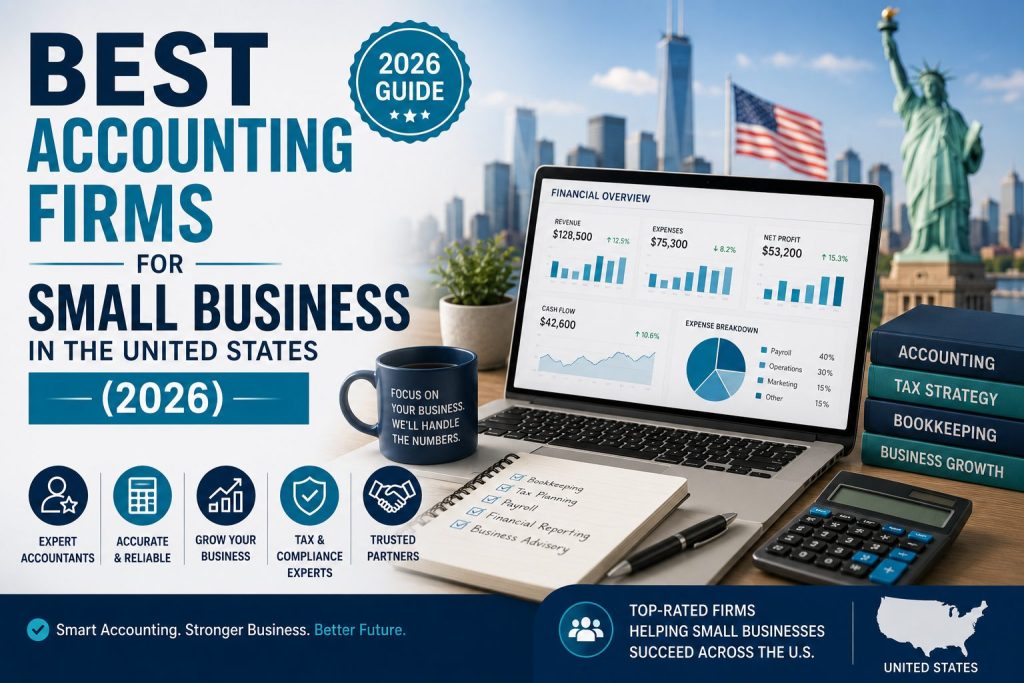




The best accounting firms for small businesses in 2026 include Aone Outsourcing Solutions, Bookkeeper360, inDinero, Pilot, and Xendoo, with various combinations of U.S. tax compliance, cloud-based bookkeeping, and pricing that rises with the size of your business. There are a variety of top-10 options listed below, along with a few considerations and a comparison of the best ones.
Running a small business in the United States involves many small operations, like juggling sales, business operations, and customer service; managing accounting is often the first thing to take a back seat. However, a stressful tax season and frequently costly errors occur with inaccurate books. That’s why it’s important to choose the right accounting firm as much as it’s crucial to choose the right software.
We outline the necessary steps for small business owners to consider when assessing the best accounting firms in the United States: industry knowledge, technology, pricing transparency and scalability, and then present a comprehensive comparison table, our top 10 accounting firms list, and answers to the most frequently asked questions that business owners have before hiring an accounting firm.
How to Select the Best Accounting Firm for Your Small Business.
Not every accounting firm is created equal; the optimal option depends on your size, industry, and objectives. Before you make your decision about the best accounting firms for small business, we will review the key points to consider.
Industry Expertise
There are accounting regulations that vary by sector. An accounting requirement for a restaurant differs from that of a tech startup or a construction company. These are some of the finer points that are known to the best accounting companies in the small business category. The best accountants for small business are aware of what costs they can charge off, which report will receive the most attention, and the regulatory measures applicable to the industry in which they are involved.
An example is that an online retailer may require the services of a company handling property management accounts, and a real estate business may need the assistance of someone dealing with sales tax in several states.
Technology and Tools
Contemporary accounting has become digital. Leading accounting companies often resort to cloud-based accounting software, such as QuickBooks, Xero, or Zoho Books. These tools enable real-time working, accessible data, and quick reporting.
Supposing your accountant continues to operate via email attachments and spreadsheets, it may be time to upgrade to a solution that incorporates automation, artificial intelligence, and secure portals to execute its functions more efficiently.
Transparent Pricing
They should be easy and foreseeable to price. The most appropriate minor accounting companies provide a flat fee every month or precise packages. Shun companies that impose non-existent charges on each minor query or feature that you did not subscribe to.
An easily understood pricing model will enable you to create better plans, and you will not experience any surprises during tax season.
Personalized Support
Small companies usually prefer a personal touch. Large teams characterize big firms, whereas smaller accounting firms are more inclined to give more committed attention. You will also have a steady point of contact that is aware of your business’s past and future objectives.
When you prefer a working relationship, you will want to select a company that values open communication and offers regular financial updates.
Scalability and Flexibility
Today, your business might be a huge difference from what it will be in two years. Select an accounting company that can grow with you – from basic bookkeeping now to CFO-level financial planning tomorrow.
It is this flexibility that will help you avoid swapping providers with each company’s growth.
Quick Comparison: Top Accounting Firms for Small Businesses
| Firm | Best For | Starting Price | Key Feature |
| Aone Outsourcing Solutions | Outsourced accounting at scale | Custom quote | Dedicated accountant, U.S. time-zone alignment |
| Bench Accounting | Online bookkeeping (post-restart) | ~$199/month | Monthly reports — see reliability caveat below |
| QuickBooks Live | Businesses already on QuickBooks | ~$200/month | Native integration with QBO |
| Bookkeeper360 | Performance dashboards + advisory | ~$399/month | Real-time metrics, fractional CFO add-on |
| inDinero | Funded, fast-growing startups | ~$750/month | Bookkeeping, tax, and CFO under one team |
| Pilot | Tech-forward startups | ~$99/month (software-led entry tier) | AI-assisted categorization, scales to accrual + CFO |
| Xendoo | Flat-rate cloud bookkeeping | Custom quote | Bundled bookkeeping, tax filing, and reporting |
| Merritt Bookkeeping | Ultra-simple, low-cost bookkeeping | $190/month flat [verify] | No transaction limits, one flat fee |
| Mazuma USA | Solo entrepreneurs and small LLCs | Custom quote | Bookkeeping + tax filing in one plan |
| Acuity Accounting | Full-service outsourced accounting | Custom quote | Scalable plans with dedicated CPA support |
The 10 Best Firms that offer CPA Services to Small Businesses.
The following is a carefully curated list of the best small accounting firms that a small business can find in the U.S. These companies are selected based on the quality of their services, cost, technology usage, and client confidence.
1. Aone Outsourcing Solutions
Best: Outsourced accounting at scale, without the overhead of an in-house hire.
Starting Price: Custom quote based on transaction volume and scope.
Why It Stands Out: Aone Outsourcing pairs each client with a dedicated accountant not a rotating support queue who works U.S. business hours and stays consistent month to month. That combination of offshore-outsourcing pricing with in-house-style consistency is the core differentiator versus larger, less personal platforms.
Best Suited For: CPA firms, startups, and small businesses that want to scale their accounting function without adding headcount.
2. Bench Accounting
Best For: Online bookkeeping and monthly financial reports with an important caveat.
Starting Price: Approximately $199/month for the Essential plan as of 2026.
Why It Stands Out and Why to Proceed Carefully: Bench was once one of the most recognized names in small business bookkeeping. On December 27, 2024, the company shut down abruptly, leaving customers without access to their books during year-end. It filed for bankruptcy in Canada in January 2025 with more than $65 million in disclosed debts, and its assets were acquired by Employer.com, which relaunched the service under the same Bench brand. As of 2026, Bench is operating again, but it currently holds a D- rating with the Better Business Bureau, and customers have continued to report late monthly closes and slower support response times since the restart.
Best Suited For: Businesses that specifically want to evaluate the post-restart Bench service should do so with clear eyes ask directly about current SLAs, data protections, and support response times before signing on, and compare closely against the more consistently stable options on this list.
3. QuickBooks Live
Best For: Businesses already using QuickBooks Online.
Starting Price: Approximately $200/month.
Why It Stands Out: Because it’s built directly into QuickBooks Online, there’s no data migration or new software to learn your bookkeeper works inside the platform you already use, with real-time visibility into your books.
Best Suited For: Business owners who want a professional bookkeeper without switching off familiar software.
4. Bookkeeper360
Best For: Businesses that want bookkeeping plus real business insight, not just compliance.
Starting Price: Approximately $399/month.
Why It Stands Out: Live financial dashboards and metrics go beyond basic reporting, and a fractional CFO add-on is available as you grow useful if you want a partner that can eventually advise on strategy, not just keep the books.
Best Suited For: Growing businesses that want more visibility into performance, not just tax-time compliance.
5. InDinero
Best For: Funded, fast-growing startups.
Starting Price: Approximately $750/month.
Why It Stands Out: inDinero combines bookkeeping, tax, and CFO-level financial planning under one team, with a focus on investor-ready reporting a meaningful advantage if you’re fundraising or reporting to a board.
Best Suited For: Venture-backed companies and technology startups that need financials built for investor scrutiny.
6. Pilot
Best For: Tech-forward small businesses that want automation plus expert review.
Starting Price: Approximately $99/month for the software-led entry tier.
Why It Stands Out: Pilot’s AI-assisted categorization speeds up routine bookkeeping, with human review layered on top, and it integrates directly with Stripe, Gusto, and Shopify. It also scales up to accrual accounting and CFO support as you grow.
Best Suited For: SaaS companies and other online-first businesses that live in these platforms already.
7. Xendoo
Best For: Flat-rate, cloud-based bookkeeping with fast turnaround.
Starting Price: Custom quote.
Why It Stands Out: Bookkeeping, tax filing, and reporting are bundled together with transparent, predictable pricing no line-item surprises.
Best Suited For: Service-based small businesses that want predictable monthly costs.
8. Merritt Bookkeeping
Best in: Ultra-simple, low-cost bookkeeping.
Starting Price: Fixed $250/month!
Why It Stands Out: One flat fee with no transaction limits makes this one of the most straightforward, lowest-cost options on this list Merritt intentionally keeps its service simple rather than layering on advisory features.
Best Suited For: Freelancers, consultants, and very small businesses that need clean books without extra bells and whistles.
9. Mazuma USA
Best For: Solo entrepreneurs and small LLCs.
Starting Price: Custom quote.
Why It Stands Out: Bookkeeping and tax filing are bundled into a single plan, with pricing built around the realities of microbusiness budgets.
Best Suited For: Freelancers and solo business owners who want bookkeeping and taxes handled together.
10. Acuity Accounting
Best For: Businesses that want full-service outsourced accounting.
Starting Price: Custom quote.
Why It Stands Out: A dedicated CPA team handles bookkeeping, payroll, and tax compliance together, with plans that scale as the business grows.
Best Suited For: Small and mid-sized businesses ready to outsource their entire accounting function rather than piecing it together.
The Smarter Way to Improve Your Accounting Processes
You don’t need a large budget or a full-time finance team to get your books under control. With the right accounting firm or outsourced partner, you move from reactive tax-season scrambling to proactive, data-driven financial management year-round.
Outsourcing to one of the best accounting firms for small business typically delivers:
- Accurate, audit-ready bookkeeping records
- Tax compliance that keeps pace with changing regulations
- Lower risk of costly errors or fraud
- More of your own time back to focus on running and growing the business
Pro tip: many small businesses use a hybrid approach — a local tax advisor for state-specific nuances, and an outsourced partner like Aone Outsourcing Solutions for day-to-day bookkeeping. It’s a combination that controls cost without sacrificing compliance.
Conclusion
Choosing the best accounting firm for your small business in 2026 isn’t about finding the cheapest monthly rate — it’s about finding a partner reliable enough to still be there next year. As Bench Accounting’s 2024 shutdown showed, even well-known providers can disrupt your business overnight, which makes a firm’s track record and stability just as important as its price or feature list.
Whether you choose a local CPA, a startup-focused accounting platform, or a full-scale outsourcing partner, prioritize pricing transparency, a proven service history, and room to scale with you. If you’re looking for dedicated, U.S.-based accounting support without the cost of hiring in-house, get in touch with Aone Outsourcing Solutions for a free consultation.
Frequently Asked Questions
Q: 1 Which accountant is the right fit for a small business?
Look for an accountant or firm with direct experience in small business finances and your specific industry. Someone who already understands your sector’s typical deductions, reporting needs, and compliance requirements will save you time and reduce costly mistakes.
Q: 2 What are the best accounting firms for small businesses?
Strong 2026 options include Aone Outsourcing Solutions, Bookkeeper360, inDinero, and Xendoo, each suited to slightly different needs — from dedicated outsourced bookkeeping to startup-focused CFO support. See the full comparison above for pricing and fit.
Q: 3 How much does an accountant cost for a small business?
Costs vary by scope: basic bookkeeping typically starts around $150–$300/month, while full-service accounting with tax and advisory support can run $500–$2,000/month, depending on transaction volume and complexity.
Q: 4 What makes a good accountant for a small business??
A good accountant is accurate, responsive, and clear about pricing — and takes the time to actually understand your business goals rather than just processing transactions.
Q: 5 Why choose a small accounting firm over a large one?
Smaller firms tend to offer more individualized attention, faster response times, and pricing that’s more accessible for small business budgets, compared to the larger, more standardized service you often get at big firms.
Q: 6 How do I choose the right accounting firm for my small business?
Match the firm’s specialty to your business type and size, compare pricing transparency and technology, and ask how they structure client communication. A short introductory call is usually enough to tell whether their communication style and reporting fit what you need.
Q: 7 What’s the difference between a local CPA and an outsourced accounting firm?
A local CPA typically offers in-person meetings and deep familiarity with state-specific rules, while an outsourced accounting firm usually offers broader service coverage, faster turnaround, and lower costs through remote work and technology. Many small businesses use both — a local CPA for filings and strategy, and an outsourced firm for day-to-day bookkeeping.
Q: 8 Is outsourced accounting a good fit for a growing small business?
For most growing small businesses, yes. Outsourcing scales more easily and affordably than building an in-house finance department, and choosing a firm with a solid, verifiable track record helps ensure consistent, reliable reporting as you grow.